Recently in Books Category

Review: In Defense of Food: An Eater's Manifesto

Michael Pollan, the author of The Omnivore's Dilemma, once again tackles the subject of food in his new book In Defense of Food: An Eater's Manifesto. The U.S. book cover has the words "Eat Food. Not Too Much. Mostly Plants." wrapped around a head of romaine lettuce, which summarizes the whole of the manifesto; instead of tracing food from the source to his meals as he did in The Omnivore's Dilemma, Pollan instead takes a look at the food-like products which fill our daily lives, and how nutritional science has altered our views on food.


The book is split up into three sections: The Age of Nutritionism, the history behind modern thought about food and the way we look at food at a nutrient-level (Vitamins C, B12, protein) rather than at the ingredient level (fruits, meat, vegetables). The Western Diet and the Diseases of Civilization, in which Pollan explores the different diseases that plague those who switch from a more traditional diet to a Western diet. And finally, Getting Over Nutritionism, in which Pollan describes how to change our diet, back to one which uses real food vs. processed food.

Review: Soon I Will Be Invincible

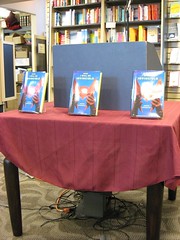
One of the things I alway wondered as a teenager was why there weren't more superhero books in the science fiction/fantasy section of the bookstore; the licensed properties section was dominated mainly by Star Trek novels and role-playing game based-novels; if you wanted to read a Batman story or a X-Men story, you had to head for the comic book rack. During this time, you had the short-story-based anthology series
Wild Cards, and a few years later another collection of shorts called Superheroes.


Managing to publish a superhero book today isn't easy. Publishers would rather be pushing out books about alien civilizations or elves, but it's probably gotten a bit easier with the release of The Amazing Adventures of Kavalier and Clay
and the success of supers at the movies lately, as well as Marvel and DC putting out novels about their most mainstream heroes.


In Soon I Will Be Invincible, the story takes the point of view of two different characters: the evil genius Doctor Impossible, and the newest member of a super team called the Champions, a female cyborg named Fatale. The whole book has a feel of being ripped from the pages of a 1940s era comic book, where villains and heroes are fairly simply defined; villains try to take over the world, heroes try and stop them. Part of the challenge of this book is creating the myriad of characters needed to populate a superhero universe, and creating the history behind them.


I don't recall if the book's author, Austin Grossman was a DC reader or a Marvel reader, but it's obvious that he enjoys reading comics, as there are plenty of homages to those familiar archetypes; Blackwolf is more or less Batman, Mister Mystic bears similarities to Doctor Strange or Doctor Fate, and there are names of superteams that ring all too familiar.


In the end I think the book tries to be too many things; it wants to encapsulate a whole superhero universe, and has to tell the origin stories of this cast of characters, and it is much too short to do it all within 280 pages. My disappointment with the book is not the writing; the prose itself is very readable, it's the lack of innovation and content involved in the book, in a storyline which feels much too predictable.


3.5/5


IMG_1424.JPG

Video of Austin Grossman Talking at Google:

Review: American Born Chinese and Shortcomings

This afternoon, I read both Gene Yang's "American Born Chinese" and Adrian Tomine's "Shortcomings". This, of course is a doubleheader of Asian-American experience inspired graphic novels, and the feeling of reading these two right after each other is the same feeling one might get by watching two Asian-American films in a row. For the most part, the two graphic novels deal with the same issue: what it means to be Asian American, and how that affects their ability to be in a relationship.


Gene Yang's American Born Chinese is told through the viewpoints of three characters: the first being the Monkey King, a traditional Chinese hero, the second being Jin Wang, a Chinese American boy who grows up in a primarily white-dominated neighborhood, with his only friend being another boy from Taiwan.
The third story centers on that of a Caucasian teenager named Danny as his Chinese cousin destroys his life and reputation at school. This third story segment involving the Chinese cousin named "Chin-kee" was the hardest for me to read through; this is partially on account of the Chin-Kee's swapping of the "R"s and "L"s in the English, along with his being a highly stylized version of a 1930s era Chinaman, with buckteeth and cue.


Adrian Tomine's Shortcomings centers on Ben Tanaka, a Japanese-American and his relationships with people. Ben Tanaka is not a likable character; he's a bitter, angry Asian male, who has a troubled relationship with his Japanese girlfriend, and his only friend in the world seems to be a Korean lesbian grad student named Alice Kim. Set in Berkeley, the backgrounds of the Bay Area are clearly seen such as the defunct University Theater, and a sign for the Durant Food Court. While beautifully drawn and inked, the character of Ben is impossible to like, and as a result, one reads through the book as merely an observer, never feeling any emotional attachment.


Of the two, Gene Yang's American Born Chinese is the easier to read of the two; the story is a visual allegory, while Adrian Tomine's Shortcomings feels more like an biographical dissection of the topic, leading to disappointment and dissatisfaction befitting the title; I expected more from Tomine, but what I received was far less.


Shortcomings: 2/5

American Born Chinese: 4/5

Barry Schwartz on the Paradox of Choice

A few years ago, I read Barry Schwartz's The Paradox of Choice,

Phillipe Stark on the Kindle

Someday I'm going to get tired of continously bashing the Kindle ebook reader, because it's such an easy target. Today, Phillipe Stark, famed industrial designer makes his opinions known about the Kindle:


Link: sevenload.com

Digital in the Real World

Cory Doctorow recently wrote an article for The Guardian entitled "Downloads Give Amazon Jungle Fever", in which he details how an otherwise smart company can be so stupid when it comes to digital downloads.


Doctorow's sentiments echo my own opinions in many ways -- especially about the Kindle and e-books. As of late, I have been reading Steven Levy's "The Perfect Thing: How the iPod Shuffles Commerce, Culture and Coolness", a book about how the iPod came to be, which has a chapter in it about the early days of the web, the MP3 format, and Apple's iTunes software, and how record companies sued each and every music distribution company before Apple came along. Apple's dealings were clever: iTunes was Mac-only, and worst case it was just a tiny percentage of the computer audience; a mere 5 percent, but even so, the record companies wanted pretty strict limitations on the rights of the users, including the number of times it could be copied to CD, and how many computers the song could be played on. What I find most interesting about the negotiations is that the record companies thought that Apple was just another middleman, another retailer like Best Buy or Tower Records, who were all too happy to give the music industry money in exchange for product. Except in Apple's case, there was no real product to supply -- no shipping costs, no manufacturing costs, it was, in the publisher's eyes, free money. The iTunes situation hasn't changed much, although I believe that more single songs are purchased from iTunes instead of whole entire albums, but it seems that with the success of iTunes, everyone is trying to emulate that model without realizing that selling music tracks is very different from selling tv shows and books.


When you buy a tv show, you're buying the whole episode, when you buy a book, you're buying all the chapters. Unlike a music album, you can't break it up into discrete units, and people aren't going to want to purchase discrete units. On a CD, it might have a good track seven, and you might want to purchase that, but I doubt you're ever see someone say "I just want the portion of the movie where Natalie Portman's family is killed by Gary Oldman in Leon: the Professional", or "I just want chapter 5 of Harry Potter and the Deathly Hallows, because it doesn't work like that -- books, movies and tv shows have a narrative structure that makes such cutouts odd when viewed out of context.


The second hurdle to overcome is the device. The iTunes store has the iPod, while Amazon is attempting to market their Kindle e-reader to become the iPod of e-book readers. When I first saw the iPod in October of 2001, I remember my reaction: too expensive, too heavy and too fragile. The Kindle strikes a different set of chords within me: too expensive, too ugly, and too few colors. These are, of course, all problems that can be fixed over time, but I feel as if many of the features of this device already exist in gizmos we already own, which relegates the device to a novelty.


If one looks at the various electronics that have succeeded over the years, one of the more common components is the ability to use the device on a daily basis. Sure, everyone loves getting a tire pressure gauge-compass-flashlight with window hammer, but it's not a daily use object like an iPod or a personal computer, and an object has to be able to make the transition from home life to work life -- e-mail and cellphones are good examples of such objects, while video games and tv sets are objects that cannot make the transition because they are much too associated with leisure activity. Personal Electronic devices such as the iPod and the Kindle fill a different segment of time, that which lies between work and home -- they exist as devices that are usually prohibited at work, but can be used during the time "off the clock", or in the space where one is neither working, but not at home -- such as breaks and the time involved in commuting.


The Kindle is an storefront for Amazon that the consumer has purchased in the guise of a personal electronic device -- nothing more, nothing less, and though they aim to make Amazon the iTunes of the reading world, digital books have not yet reached the point that I would want to replace my physical library, regardless of the amount of space they take up.


Going digital only serves to do one thing: make companies ridiculously greedy, particularly if what they are selling does not truly belong to them, as in the case of music, movies, books and tv shows. You see, the true IP owners are the creators or writers of the material, but negotiations, contracts and other deals have relegated the original creator to merely being a shareholder in their own work, with most of the power of ownership and distribution belonging to the publisher. This reversal means the purchaser of the product is dealing with the publisher, whose goal is to entice the buyer to buy more product. This relationship is apparent is the dealings of every company in the digital downloads industry -- and which I believe runs counter to the common sense definition of ownership.


I own a huge library of media -- CDs, DVDs, books. I paid for them, and thus I feel free to do whatever I please with them -- if I want to give them away or sell them, I am free to do so. If I want to loan them out or shred them for an art project, I can do that as well. Amazon's digital downloads restrict me in a number of ways:


  • No resale. This isn't a big deal, since most media I end up buying is stuff I want to keep, but it does hurt in bargain shopping, as you will never find a digital download in the "pre-owned" section.
  • No gifting. The digital download model makes it inconvenient, if not impossible to give someone a book, a movie or an album -- you'd be better off just giving them a gift card.
  • No borrowing. Because the media isn't physical, companies don't want you passing a file to your friends (or to the internet).
  • No recyling. A bad book can be tossed into the garbage or donated to a library, or turned into an art object, but there's nothing you can do with a digital download other than clear it off your hard drive.

One of the interesting things about music collections and the iPod is that the iPod didn't invalidate my music collection; the Kindle wants me to replace my physical books with virtual ones -- but Amazon's rights to change the content of the e-books, or remove/delete them goes against any real-world term of ownership that I know of -- if anything, it's much more like a service fee that says "someday this content might not be here, but today, you can use it."


Lastly, Amazon is a store. They are good at selling things and keeping inventory, but they should not be in the business of making devices, supporting devices and managing digital content (just as they never should have been in the search engine business). Does the Kindle generate buzz? Yes, but it's negative buzz about the device and their policies, and I don't see that helping them.


My own strategy for the Kindle would have been a plan for physical books to become digital ones, by scanning in the barcode and inputting a random word on a random page, I'd be willing to do this, even with a small surcharge for the conversion process, as it means that I'd still have a physical book, but I'd also have a digital one for when I'm traveling about. Sadly, what Amazon has chosen to do is little more than a method for people to pay money to rent a book.

The Golden Compass Off to a Slow Start at Box Office

The movie adaptation of the Golden Compass opened this weekend, pulling in $27 million dollars in box office revenue, and being number one, but as far as family films based on book adaptations go, this is not a good sign, as $200 million was spent to make the film, and other films have had substantially larger opening weekends:


    Harry Potter & the Goblet of Fire - $102.6M opening

    Harry Potter & the Prioner of Azkaban - $93.6M opening

    Harry Potter & the Sorcerer’s Stone - $90.2M opening

    Harry Potter & the Chamber of Secrets - $88.3M opening

    The Lord of the Rings: The Return of the King - $72.6M opening

    The Chronicles of Narnia - $65.5M opening

    The Lord of the Rings: The Two Towers - $62M opening

    The Lord of the Rings: Fellowship of the Ring - $47.2M opening

    The Golden Compass - $27M opening (estimate)

    Eragon - $23.2M opening

    Bridge to Terabithia - $22.5M opening

    Stardust - $9.1M opening


At least it's doing better than Eragon.

Another Day, Another Entry on Kindle

I don't know what's been afflicting me, but I just can't stop talking about the Kindle, Amazon's new e-book reader. Maybe it's because I want it to die a spectacular death, since I don't want my book buying experiences for the rest of my life to be done on the Kindle.


I do find one thing to be of particular value on the Kindle, which also might be the sole reason for purchasing one: EVDO for free. EVDO is a wireless standard that is used on cellphone networks to transmit data. Currently, to get unlimited EVDO service on Sprint, it costs about $60 a month.


The Kindle is a standalone device, meaning that it doesn't require a computer, but it does, like many other cellphones, use a USB 2.0 for transfering larger blocks of data. I suspect that with a small number of Kindles having been delivered to the American public, it probably won't be long before it's torn apart, and someone figures out how to make the Kindle to act as a wireless access point.

Amazon's Kindle Sells Out in Less Than 6 Hours

Apparently, myself and the rest of the tech world that slammed the Kindle for being essentially a portable Amazon storefront, were way wrong when it came to the Kindle -- people are willing to part with $400 for a Kindle, because Amazon's stock of Kindles has apparently sold out in less than six hours.


Of course, we don't know how many were in that stock, but the relative availability of the Kindle (more to be shipped out next week on 11/29) suggests that this initial stock was meant to be large enough for some people to say "I got my Kindle!" while still producing a good number of hours for selling out. There's no incentive for Amazon to have a large amount ready to ship on announcement -- the way Amazon works, someone's not likely to cancel an order just because they have to wait a week for it -- no one else is going to sell Kindles except Amazon. They just need that number to be large enough such that if someone does ask how many they sold on the first day, it's not something ridiculous like 10.


I assume the initial stock was extremely limited, perhaps no more than 10,000 units. This is Amazon we are talking about here -- the company that sells out of their Wiis in a few minutes. 10,000 is a respectable number -- it's a large enough number that Amazon can say "That's all that we could have in time for the announcement", and it's small enough to say "We sold out of them in a few days". The fact that they sold out in 6 hours suggests that the inital allotment may be even less than 10,000 units. My own personal guess to the number is in the range between one and three thousand. If we work backwards from Nintendo's example, they sold 600,000 Wiis in a week, which becomes about 1 Wii sold per second. Even if Amazon were to sell 1 Kindle every second, that calculates into -- 1 x 60 x 60 x 5 = 1,800.


I love books, but when I logged onto Amazon yesterday morning and saw the announcement on the front page, my initial reaction was not to click the "Buy Now" button, but to read more about it. People have been saying that it's the iPod for books, but that's not accurate, because of the one big difference. The iPod never asked me to buy a whole new music library for my device. All the CDs I had didn't suddenly not exist to the iPod. The Kindle is asking you to pretend your book library doesn't exist. If you want your book on the Kindle, be prepared to shell out some money to have a digital copy of the book.


What I'd like to see implemented on Amazon is that they make available digitally any book I purchase physically. Give me an incentive to buy a Kindle, and to read my books on it. My physical book library will long outlast the Kindle's lifetime, and probably my own lifetime.


Cory Doctorow of Boing Boing had this to say regarding the Kindle:


    Here's the biggest mystery of the Internetiverse for me today: why is it that Amazon, the most customer-focused, user-friendly company in the world of physical goods, always makes a complete balls-up hash out of digital delivery of goods? You'd think that they'd be the smartest people around when it comes to using the Internet to sell you stuff you want, but as soon as that stuff is digital, they go from customer-driven angels to grabby, EULA-toting horrors. Why does the Web make Amazon go crazy?

This mystery is definitely something that's been on my mind -- Amazon has been great to me for buying books and other items -- I'll gladly plunk down 2 or 3 grand for a new camera, but when it comes to digital media, Amazon has yet to earn a single penny from me, and part of that is due to the feeling that something that exists purely as a DRM-locked digital file isn't permanent enough. That being said, the field of e-books is a frontier yet to be explored, but I've yet to see a system that works. This is a good try at trying to re-invorate the market, but I suspect that the winner of this will be someone who can make the experience more like a real book and less like a giant PDA.

Amazon Kindle E-Book Reader

amazonkindle.jpgAmazon has just launched their Kindle e-book reader. Sporting a display of 6 inches with 167 ppi of electronic paper (e-paper) resolution, and weighting just 10.3 ounces (about the size of a small paperback book), it features both Wi-Fi and has a built-in EVDO modem.


The EVDO modem utilizes the cellphone network so that hunting for a Wi-Fi hotspot isn't necessary, making books available to purchase anytime you can get reception from the Sprint network. Despite the fact that it uses Sprint, there's no fees and no contract for using the wireless network. Can you surf the web on it? Yes. Can you e-mail from it? Yes, for 10 cents per e-mail.


The design of the device feels a mite unfriendly (and ugly) to me, with the buttons for next and last page mounted on large buttons on the sides of the device, I feel that you're essentially holding the Kindle at the bottom of the device, rather than the middle, which I believe may be problematic. The keyboard is a good idea, but I feel the keyboard should have been hidden in a sliding design, as the only time you need it is a small percentage to the main function of the device, to read books.


Keeping in mind that this device is released by Amazon, their motivation for releasing this device is pretty clear: they want to sell you reading material. Despite the free wireless service, putting anything on this device has a cost associated with it. Unless otherwise marked, all New York Times bestsellers and new releases are 9.99 or less, and magazines and newspaper subscriptions are reasonably priced and are priced on a monthly basis such as the New York Times for 13.99 a month, and TIME for 1.49 a month. Since the new media publisher is the internet, high volume blogs like Boing Boing are also available on Kindle for 1.99 a month. While I read Boing Boing daily, much of their content is based on providing links to other sources, and I'm curious if being part of Amazon's subscription is going to change their style of writing up articles. Content being offered for Kindle of course, provides another alternate revenue stream for bloggers and authors.


While I think the Kindle e-book reader is a revolutionary new attempt at e-books, it falls a little short of being a book replacement for me, for a number of reasons. The price of the reader is $399.99, and while that's as much as an iPhone, it does depend on multiple pieces of technology that may or may not exist in the years to come.


  • EVDO network. Sure, it's currently one of the standards that we're using, but what happens when that technology is phased out?
  • The Kindle and Amazon.com. The Kindle has a number of features locked into Amazon, including how to buy, download and store purchases. Lose your e-reader? Not a problem, as all the books are kept in your Amazon media library and available for download.. However, your e-books are at the mercy of Amazon -- should they decide to switch data formats or discontinue the Kindle program, you could end up with an largely unsupported device.

While I don't mind paying for new books, with the Kindle you can't really loan them out like you can do with a physical book. You can't re-sell them like normal books either. The prices for paperbacks are similar to new prices of paperbacks, meaning that old books like Snow Crash is priced at a somewhat mind-staggering $7.96, a $2.24 difference from Amazon's current retail price of 10.20 (my physical copy of Snow Crash cost me 5.99 in 1993, and will still be usable until the paper of the book disintegrates) while something really old like Foundation is $3.99.


The big worry on my mind is obsolescence -- while one would assume that should the Kindle program succeed, newer, faster, better e-readers would be on the horizon, and essentially you're paying $400 for an e-book reader that might be replaced in a few years. Which leads me into the ecological impact of e-books. On one hand, they save paper, but each e-book reader also generates an amount of dangerous e-waste in the process of manufacturing and disposal, and books decompose with less ecological impact, as most of the material will just naturally breakdown. The plastic case and the circuit boards shouldn't be disposed of in the garbage, but I'd say that a small proportion of them will still end up there, unless Amazon has a trade-in/used program for the future.


The applications for Kindle I see mostly using it for would be, interestingly enough, the things that they don't have on the device yet -- maps and photographs/graphics, both of which would require much higher storage capacity. I can see this being useful for educational purposes -- provided that a future Kindle would have color and graphics, you could have all your textbooks on one device, in much the same way that an iPod allows people to contain their entire music collection in their pocket.


It's a good idea, however, I feel that the initial implementation isn't polished enough. Time will tell if this is the future of e-books or just another electronic novelty.

Pages

Powered by Movable Type 4.2rc1-en

About this Archive

This page is a archive of recent entries in the Books category.

Blue Comet Games is the previous category.

c'est la vie is the next category.

Find recent content on the main index or look in the archives to find all content.