June 2007 Archives

AX2007: This is NOT the line for the iPhone

IMG_8485.JPG


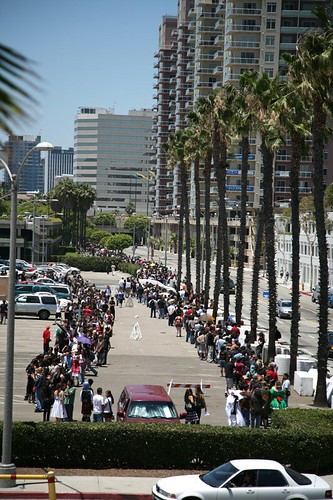
This is the line for those that didn't pre-register. This is shot from a parking lot that ends at E Shoreline Drive. (more than 3 1/2 blocks away from the convention center entrance.


IMG_8496.JPG


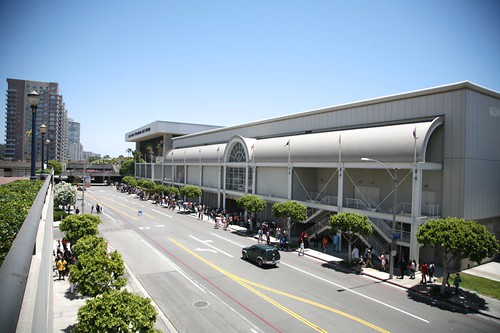
The photo above shows the line for those that did pre-register.


Now, what you have here is a complete breakdown of the system. What should have happened is that a lot of people *should* have gotten their registeration badges in the mail. They sent them out late, and while I had thought that my badge was one of the oddly late sent badges, apparently lots of people did not receive their badges, and you have a line of pre-regs that stretches all the way from Pine to Beach Blvd 2 and a half blocks). These are not short blocks, but long useless Long Beach blocks. From the back of the pre-reg line to the front of the pre-reg line took 2 hours. Quite disgusting it was.


That's not the worst part, however. The Long Beach Convention Center is big, yes. It can accomodate 10,000 people in their arena for concerts and other events, but it is far too spread out to be a good convention hall. Hopefully next year, they can move it back to Anaheim.


This, along with other photographs can be see this Anime Expo 2007 set

links for 2007-06-30

links for 2007-06-29

Looking for the iPhone?

Apple has a new page up called the iPhone retail availability tracker, in which the status of iPhones at the Apple stores is updated (on a overnight basis). Right now they're showing all green, but I expect by tomorrow evening, a lot of those green dots are going to be red.


Seeing such systems in place makes me believe that this launch is going to be huge beyond expectations, but that they wouldn't put such a system in place if they didn't expect to sell out.

Fun at the Game Store

What happens when two old veterans of game design at a game conference in Bloomington, Indiana go into a local game shop? (as told by Richard Bartle):


    Lad: You play World of Warcraft?

    Randy: Well, I have a level 65, but I've never been to MC as I'm not in a raid guild.

    Me: I've pugged it a few times. I have three 70s, a 60 and a 20-something.

    Lad: I have two 70s. Hey, I think it's really great that people of all ages play WoW.

    Me: Well, we have been playing this kind of game for a while...

    (Randy glances at me with an "are you going to do it?" look).

    Me: What was World of Warcraft based on? What game did the developers look at and think, "we can do that, only better"?

    Lad: Er, was it called EverQuest?

    Me: That's right. Do you know what EverQuest was based on?

    Lad: No, but I think there was some guy at IU who gave a talk...

    Me: EverQuest was based on DikuMUD, which was a textual world developed at the Datalogisk Institut Kobenhavns Universitet in Denmark. DikuMUD was based on AberMUD, written at the University of Wales at Aberystwyth. AberMUD was based on MUD, written at the University of Essex in England. MUD wasn't based on anything. I co-wrote it.

    Lad: You wrote it?

    Me: The first graphical virtual world was Habitat, written in 1985 by -- who wrote Habitat, Randy?

    Randy: Randy Farmer and Chip Morningstar.

    Me: We've been writing and playing these games since before you were born.

iPhone: A Short History of Lines

With the dawn of the new age of cellphones approaching in less than 2 days, I started thinking about technology, and how human anticipation of new technology has occurred.


This whole phenomenon of people camping overnight for a new product is something rather recent. Sure, we all know about the crazy Star Wars and Lord of the Rings fans who pitch tents and forsake creature comforts to buy tickets for first day showings, but that's entertainment, and people have been lining up for entertainment for centuries.


What happens on Friday, however is not the opening of a new movie or amusement park, but the release of the iPhone, a highly anticipated cellphone from Apple. Apple in the past has made the products available as soon the announcement is made. The iPhone has had a severely different play from all of Apple's other current products -- the release date of the iPhone was known weeks in advance, and as a result, people have already started lining up in order to be the first to lay ownership of the iPhone. People don't line up for new iPods, MacBooks, AppleTV or any other Apple branded products, but for some reason, people feel inclined to line up for the iPod cellphone.


To step things back a little bit, the last couple of camping lines for electronics has mostly been in the field of video game systems. People just don't do midnight sales or anticipate the release of a new DVD player or vacuum cleaner the same way people seem to be willing to wait for the latest video game system. The Wii had campers. The PS3 had campers as well, which was highly televised, with some people waiting out for days. The Xbox360 also had campers (and a slew of price gouging by big retailers), but we didn't have campers for the previous generation of game systems. PS2, GameCube and XBox were all readily available on their release date, and while all three sold out, they didn't involve camping. Super Nintendo, Nintendo 64, Genesis, Saturn, Dreamcast, not one of these required the average person to camp to receive one on launch day. You walked into a store, asked if they had it and purchased it if they did. In most cases, one went to Fry's or Toys 'R' Us where their floor was littered with shipping palettes of the systems. So I'd say that this whole lifestyle of camping for consumer electronics started back in November of 2005 with the launch of the XBox360.


The reason for the camping of the XBox360 had to do with the timing; Christmas shopping season was about to start, and with known shortages of the new system, people were desperate to obtain one. Nintendo and Sony's newest game systems wouldn't release for another year, which, Microsoft hoped could get them a head start on the marketplace. Any retailer will tell you that all game systems sell out at Christmastime. It doesn't matter how bad the system is, someone's grandmother will come in, see it on the store shelf and purchase it for her grandchildren, who will say thank you and smile, but look upon the system in the same way that one looks upon handmade clothes received for birthdays when they were 10.


I have always harbored suspicions that Microsoft engineered the shortages for the XBox360 as a form of free advertising, a form that we've seen repeated with Sony and Nintendo's latest offerings. In fact, as I write this, the Nintendo Wii is still largely unavailable and outsells Sony's PS3 on a scale of over 5 to 1 in America.


With Microsoft, they've long held a tradition of encouraging retailers to have midnight sales, and in fact, part of the origin of the midnight sales lies with Microsoft and an operating system known as MS-DOS 6.0. MS-DOS 6.0 was released in 1993. In those days operating systems were a fierce market, with products like OS/2 and DR-DOS competing to be the OS on your PC. CompUSA and other computer retailers were bound by an agreement not to sell the product until a specified date, which meant that legally they could start doing so at midnight of that day. Since this was a product that people needed on their computers (and because upgrading to a new OS was much easier than it is now) retailers figured out that if they could be the first one to sell the product, they could get a head start on their competition, which would be closed until morning. Retailers found this beneficial, and every operating system released by Microsoft since then has had a midnight release: Microsoft Vista, Windows XP, Windows 2000, Windows 98, and Windows 95. Each of these midnight sales have each helped propel headlines in the local paper the next day such as "Microsoft sells 500 copies of Windows 95 at Fry's after midnight", which in addition to all the other advertising, promotes the availability of something in the pre-internet age, when people relied on word of mouth and telephone calls to figure out the availability of a product.


We have the internet now, and the world is incredibly and openly accessible; no longer do I need to drive to multiple stores throughout town to compare prices, I can now call someone using my cellphone who can look up the prices online. I can have reminders sent to my e-mail about the release dates of various products, and rather than anxiously waiting in line for a product, I can pre-order it, and have it sent to me on the day of release. That was where the world was headed; then somewhere along the line, some bozo somewhere in a suit decided that on-line retail's limitation was going to be brick and mortar's strength, and that was being able to get the product in the consumers' hands before delivery services could make their deliveries.


I've seen countless movies at midnight showings -- those are fun because the people in the crowd genuinely want to see the movie, and the crowd interaction is vastly different; it's like seeing a film with 800 fanatical fans. They cheer at the heroes, they boo and hiss at the villains, and before the show they draw their lightsabers and have duels before the show starts. Midnight retail experiences are something else all together; people are cordoned into lines with stanchions, much as you would see at the Happiest Place on Earth, but the environment there is anything but happy; people have been sitting out for hours, maybe even days in some cases, and they're cranky, eager to fork over their cash so that they can go home, list it on eBay and be done with it all. They're afraid of supply running out before the line gets to them, and everyone is on edge, wondering if that guy chatting with the people in front is a reporter or a cutter. Not everyone out there is a fan, but everyone else out there is competition. These midnight sales have grown more popular over recent years, and show no signs of stopping; as for myself, I'd rather get sleep and know that UPS will bring it over in the next day or two.


Having a line for a cellphone is unheard of and even lines for the newest iPod is unheard of. But the iPhone is the answer to attaining nothing short of technological rapture, the symbolic object of lust for nerds and geeks everywhere. For them, this is their pilgrimage, in patient waiting for Apple's answer to ubiquitous computing. The lines outside of stores are products of the hype machine, fears of shortages, and a bit of media sensationalism. It's not as if these iPhones are going to be some Apple iPhone Premiere Limited Edition, they're a revision 1 product, which will no doubt be followed by revision 1.5, and revision 2 and so on with more and better features.
links for 2007-06-28

Last iPhone Related Entry of the Day

Sometime today, the embargo order on journalists who received demo iPhones to talk about the iPhone was lifted, and the reviews are overwhelmingly positive.


David Pogue of the NYT has a hilarious video about the iPhone (and trying to keep his mouth shut about it):


In his print article for the New York Times, Pogue headlines with "The iPhone Matches Most of Its Hype, and sums it up with "But even in version 1.0, the iPhone is still the most sophisticated, outlook-changing piece of electronics to come along in years. It does so many things so well, and so pleasurably, that you tend to forgive its foibles."


USA Today wrote Apple's iPhone isn't perfect, but it's worth of the hype, and Wall Street Journal's Walt Mossberg spent two weeks with the iPhone running through a battery of tests.


Overwhelmingly, the journalists all thought the iPhone itself was a great product -- their greatest common criticism was the service provider (AT&T) whose lack of good service area and their darn-slow EDGE network is definitely a drawback. As someone pointed out in one of the reviews if Verizon's slogan is "Can your hear me now?", then AT&T's is surely "I'm losing you".


Stephen Levy of Newsweek titled his piece At Last, the iPhone. It's 7 pages of prose and praise over the iPhone's features. I'd swear the man was actually gushing over this new gadget, if not for the single half page where he covers the drawbacks. Though to be fair, he does spend some time blasting AT&T's EDGE network. (Do you notice a trend emerging here?)


Consumerist even has a list of 6 ways to get out of your current cellphone so you can get an iPhone.


While having to use EDGE can be a horrible experience, the abundance of WiFi spots can surely make up for it -- and it's hardly a deal-killer.

links for 2007-06-27

Even A Dark Lord of the Sith Needs to Shop

Earlier today, I had clips of celebrities in commercials for the Nintendo DS. In this one, we have Darth Vader demanding a toaster.


This is not the first time that Darth has appeared on TV for a store chain, as he has previously appeared in an ad for Target:


Jon Stewart on Dick Cheney

Last night's Jon Stewart had two great segment on the Daily Show about Dick Cheney, where Dick Cheney claims he's not a member of the Executive branch of the United States, and where John Oliver draws parallels between Cheney and ancient gods of mischief.

Super Smash Bros. Brawl

One of the games I'm really looking forward to this year is Super Smash Bros. Brawl for the Wii. They've been doing a great job updating the website with all sorts of things to look forward to. In their latest entries, they preview the medley for Legend of Zelda: The Ocarina of Time, and reveal Princess Zelda (from her Twilight Princess incarnation) as a playable character.

Must Resist... iPhone's Power of Convenience

Today, Apple and AT&T released the details about the rate plans for the iPhone and the activation process for the iPhone. The cheapest monthly rates for the iPhone is $60 a month, which gives 450 minutes, unlimited nights and weekends, visual voice mail, unlimited mobile to mobile, and 200 sms messages a month. Each $20 increment nets an additional 450 minutes a month. Personally, I don't find these rates too bad, and rather in line with comparable data rate plans.


Here's what I like about the process: getting an iPhone is the same as buying any other consumer electronic good. You simply go into the store and you buy it. When you get home, you register and activate the phone, and you're done. For someone who loves gadgets, I despise cellphone stores and the process of authenticating you before they sell you a phone. (Come to think of it, I think I had to sign less paperwork to buy a car than to buy a phone). In short, the process of buying the iPhone will be very fast on Friday, with the only slowdown being the tables of iPhone accessories that one can purchase.


As just another consumer good with online activation (making it really easy to switch carriers, and transfer phone numbers) I feel that this is going to really change the mobile phone industry; for the first time you can actually buy a cellphone as a gift (and not a pay as you go crap phone).


I expect the iPhone to sell out this weekend; and while the initial cost of the iPhone might be tough for some to swallow who are not used to getting unsubsidized phones, the reasonable data and phone rates are going to net a lot of people who pay the same for a less functional Nokia or Treo on their current cellphone provider.

How to get an iPhone in the UK

With just 3 days left before the launch of the iPhone in the United States, people have already started camping out in line for an iPhone in New York City. For other countries, however, the release of the iPhone is a very vague date, like "sometime in 2008". Britain's Tech Digest has an excellent article on how an enterprising Brit can acquire an iPhone. Their list includes a pound by pound breakdown of the different routes one may take, including flying out to New York and camping for one. My favorite, though is to:


    MAKE AN INTERNET FRIEND BUY ONE

    You must know someone who lives in America. Come on, someone in your Warcraft guild must live out there? One of your blog readers? That random woman you occasionally talk to on Messenger? Pay them a 20 percent commission and try to get a couple sent over so you've got one to eBay yourself for a vast profit. And make sure they mark the package as a "gift" and say it's only worth $5, so you don't get done for import duty.


    TOTAL PRICE: £300


Nintendo DS Commercials

When the Nintendo DS Lite debuted last year, many retail locations were including Brain Age for free with the purchase of the DS Lite. Brain Age is one of those odd games that seems to capture everyone's attention. In Japan, they have classes specifically to train adults to use the Nintendo DS and get better (younger) scores on Brain Age. The Japanese Brain Age also scores using Kanji identification, while the Brain Age for the English-speaking countries has been changed to reflect the verbal and drawing abilities of western players.


Here's Nicole Kidman sitting at home and playing Brain Age on the Nintendo DS Lite in a commercial: (I believe this for the UK market)


This is not the first time Nintendo has used celebrities to help sell their DS systems and their games, as Japanese pop star Hikaru Utada helped demo the DS system before its release in Japan in 2004:


Of course, she doesn't just sell the system, but she kicks butt in Tetris DS too.


During my trip to Japan last year, I saw a slew of DS commercials advertising the New Super Mario Bros. -- the actress in the commercial is actually Japanese actress Nanako Matsushima, who starred in Ringu and GTO. In this compilation of commercials, she's pitching for the New Super Mario Bros. and the Point-and-Speak travel guides. In Nanako's case, it's for the Thai version of the popular travel program.


Because of the wide array of games as well as utility programs, the Nintendo DS Lite has been in perpetually sold out in Japan for more than year. Because of the demand, even in Akihabara, a used Nintendo DS can sometimes cost more than a new one.

links for 2007-06-26

Grocery Shopping Queue Management

For a long time, I had one rule when it came to supermarkets: they were off-limits on Sunday evenings. The reason for this had more to do with the line at the checkout stand than anything else; before I established this rule, the Sunday evening shopping experience was terrible, with what seemed like every soccer mom on the peninsula in line with their cart piled to the top with groceries. Even Express lines, with the 10 or 15 item limit were crammed with people. A wait for 10 to 15 minutes was not uncommon. But the skill of picking the right line was something I never learned; was it better to pick the line with less people with bigger carts or pick the line with more people and less items? If there's only one person with a shopping cart full of items, and 3 people in the express line with 10 items each, which does one choose? Is it better to be behind the person with the shopping cart full of packaged goods or the one who just has produce and a dozen cans of cat food? Which customer is going to be the one who drops a purse full of coupons into the cashier's lap? Which one will pay by check, and which one will need to try 3 or 4 credit cards before they get one that isn't denied? Which cashier is going to be the one who makes a mistake and needs to call the manager to unlock their terminal? When should one take the long line in the hopes that another register will open? Over the years I've tried to create a couple of simple rules to follow when making line choices. I've been right as often as I've been wrong, which in short has created the rule of simply avoiding the need to make that decision by not going to the supermarket on Sunday evenings.


The supermarket is one of those places that's a living testament to the The Paradox of Choice; while one needs to decide between all the different products littering the shelves, even down to the choice of checkout lines, we are assaulted by choices from the moment we enter to the moment we exit the store.


A few retail chains have embraced the single queue system, and in a recent New York Times article, Whole Foods in New York City has become a single queue as well. No longer are customers faced with the choice of needing to pick the "faster line".

links for 2007-06-25

links for 2007-06-23

Zelda: Phantom Hourglass Intro


I can't wait, but the English version doesn't hit US shores until October.

links for 2007-06-22

Too Much Violence gets Manhunt 2 labeled "Adults Only"

ESRB stands for the Entertainment Software Rating Board -- they're the organization that assigns all the ratings to games, handing out E, T and M to all the games you play on your console and your computer. This week, they gave Manhunt 2 (Developed by Rockstar Games and published by Take-Two Interactive) an AO. AO stands for Adults Only, and it pretty much tombstones the game from being released, as no gaming console will release an AO game. (There are 31 games (since 1992) with Adult Only 18+ rating, and they're all for the PC)


Rockstar and Take-Two essentially have 30 days to clean up and make changes to Manhunt 2 to slide it under the 'M' rating.


An AO game is classified thusly:


    Titles rated AO (Adults Only) have content suitable only for adults. Titles in this category may include graphic depictions of sex and/or violence. Adults Only products are not intended for persons under the age of 18.

As far as I can tell, Manhunt 2 doesn't include sex, which means that this game must be graphically violent to have obtained this rating. I'm not a big fan of violent games, but I'm going to bet that there are games that are equally as violent that have managed 'M' ratings.


Since Take-two was the company that announced this pending AO rating, I highly suspect that this is partially a publicity stunt to raise sales of Manhunt 2 (this is Rockstar and Take-Two, the same people who sold millions upon millions of copies of Grand Theft Auto). This game is banned in the UK, and in it's current form will not be released in the U.S. These are two huge markets for Take-two, so I fully expect them to go back through and edit out some of the game to make it fit under the M-rating:


    Titles rated M (Mature) have content that may be suitable for persons ages 17 and older. Titles in this category may contain intense violence, blood and gore, sexual content and/or strong language.

I mean honestly, think about it -- in just about every shooter out there, you're given dangerous weapons, and when you die, you explode into giblets. A quick look at ESRB's listing of M games reveals a large share of them containing some of the following: "Blood and Gore, Intense Violence, Strong Language, Sexual Themes, Partial Nudity, Drug References", so it really puzzles me that one game out of the hundreds of games that are released annually can manage AO. It must be horrifically violent to have managed this -- far beyond that of splatterhouse gore. Still, time will tell what will become of Manhunt 2 -- one way or another, AO won't be the rating it'll be released with.

Super Mario on Tesla Coils

The Geek Group of Austin, Texas has constructed some singing Tesla Coils.


It can play other songs like the Tetris theme, as well as other geeky songs like Weird Science. A more in-depth video explanation of how the Tesla Coil works.

links for 2007-06-21

Gaming Cycles

Lately, I've getting back into my old hobbies once again, which are to put it generally, Books, Photography, Gaming, and Anime. (Though not necessarily in that order, and sometimes mixed together). All of those hobbies have separate divisions -- within Books, for instance, there's fiction, non-fiction and comic, while Gaming encompasses board, video and card. Recently, I've been playing a lot of card games, or more specifically, Magic: The Gathering. There's been a bunch of competitive events, and my friends have been attending them. I haven't really felt my skills at the competition level, so I've been helping them practice, which has re-ignited my interest in the game.


Way back in 1994, I played my first game of Magic: The Gathering. On a whim, I picked up a couple expansion packs of The Dark, and a revised starter pack and started to play with the people in my dormitory. It was great back then, because it was one of those games that didn't take at all long to play -- you could cram in a game or two during a study break.


By 1994, collectible card games were all the rage, and a collector's market had sprung up overnight -- Moxes and Black Lotuses were a ridiculous $20 - $25 back then, a price that was unfathomable to me for a piece of cardboard (these days such cards fetch upwards of and average of $350). Every game company had their own CCG (collectible card game), and some game companies made a shift in strategy from other types of games to doing primarily CCGs. The whole CCG market in those days reminds me of the shift that has occurred in the MMO marketplace, where companies are licensing existing properties to make games, which make money in the short-term, but lose money in the long-term when the novelty of the property wore off.


In MMOGs, a big criticism of the genre is that the more time you spend on the game, the better your character tends to be, not necessarily because one is skilled, but that one can maximize the relationship between the flat monthly fee and the time they can afford to spend playing. This has given rise to a slew of third party merchants, from those who offer to level your character up, to those who would sell you in-game items for real world cash, to those who exchange game money for real world cash. While I think that paying real-world cash for in-game items defeats the purpose of playing the game, it is a business model that can only work outside of the United States. Doing baseline calculations 2 years ago using the WoW gold to real world money exchange rate, I surmised that the average gold farmer makes about 30 cents per hour -- hardly good money.


In CCGs, the criticism is that creating a collection of cards to be competitive is expensive. This has always been true from the beginning (and why, I, as a poor college student had no more than a few hundred Magic cards), eBay has changed this landscape considerably. The old way of acquiring a collection was to buy several boxes of boosters, and hope for the best. You'd then fill out your missing cards by shopping at gaming stores or at conventions or trading with people. Now you just go to eBay and buy the cards you want. Still, a competition set will cost on the order of several hundred dollars, depending on the size of the set. True competition play hadn't really been established in the early days of CCGs, and policies for deck construction hadn't really been defined yet. I always considered it an accomplishment if I was able to have one of every card in a set, and now to be competitive, one should have four such sets. Magic isn't a cheap hobby by any stretch of the imagination (well, if you want to be competitive/pro player -- if you just want to play and have some fun, it doesn't need to cost anywhere near that much).


With all of these drawbacks, why should I be entering into the fray of Magic: The Gathering again?


I'm pretty sure I've been seduced by the siren song of nostalgia. A few months ago, they released "Time Spiral", which had an interesting marketing gimmick: as part of the set, they'd include "timeshifted" cards, which were older cards from past sets that would be reprinted with the original art and card frames. There were old favorites in there, old cards that hadn't been seen in a set for over 10 years, which I thought was an excellent way for players to get interested in Magic again. Their followup to Time Spiral was Planar Chaos, in which they re-released cards with the same functionality, but in different colors. In their final set of the Time Spiral block, Future Sight, their timeshifting gimmick had more to do with possible future cards with a new card layout (which doesn't really entice me as much as the other two gimmicks).


In both MMOGs and CCGs there seems to be a certain amount of start-up cost -- for a MMOG, you've got a computer, you've got the DSL line, there's the monthly subscription fee, while for Magic, you've got the cards. Of course, the nice thing is, with Magic, after you're done, you can always sell the cards. With MMOGs, the selling of virtual property is a little more difficult (but still doable, unless the MMOG is totally shutdown).


It seems that Magic (and probably MMOGs as well), for my gamer generation has taken the place of a weekly poker night or a Saturday morning round of golf.

links for 2007-06-20

Beautiful Katamari


I'm crossing my fingers for a Wii version, as I don't really see a need to own a Xbox 360 or a PS3 at the moment.

links for 2007-06-19

iPhone: Now with more battery life

A recent story about the iPhone entitled "
The iPhone will fly and keep flying", and the news of the iPhone having even greater battery life than previously announced has sort of set this Monday morning off with quite a commotion.


competitivedatachart2.jpg


The Apple iPhone is an interesting device to discuss, if only because Apple has (even before the release of the iPhone) changed the landscape of cellphones forever. Let's start off with the basics -- it's a $500 ($600 if you want the 8GB version) phone that does it all -- WiFi, camera, plays audio and video with a very nice display, and to top it off, has a slick touchscreen interface. It's the cellphone that all the other cellphone companies are saying that noone wants, and it's the phone that consumers seem to be going gaga for. Almost all experts and analysts are predicting a huge success for Apple, and I'm inclined to agree. Consider this -- at MacWorld SF 2007, where over 45,000 Mac fans saw the iPhone (and took pictures, video and pressed their noses up against the glass) while it rotated in the locked glass case, these past 6 months have only fed the desire, and statistically speaking, a quarter of people with cellphones have had their 2 year contracts expire during these past 6 months. Demand, despite it's $500 price tag will be huge. Consider this: If we take out the functionality that a new 4GB iPod nano offers, it makes the iPhone a $300 cellphone/digital camera/internet with a touchscreen.


Portability and price has always been a big deal in cellphones -- in general, the more portable the cellphone is, the more expensive it is, and the more features it packs to justify that price. Palm can get away with selling the Treo because it's a Palm Pilot organizer and a cellphone -- but it's a pretty bulky phone. Motorola's Razr on the other hand is much less functional than a Treo, but has that nice compact form factor that everyone likes. The iPhone is just as feature packed as the Treo (but the Treo lacks Wi-Fi) and costs more, but it's even slimmer.


What makes the iPhone different from all the rest is that it promises a more usable interface than their competitors. I own a Nokia -- it's the same cellphone I've used for 3 years. It has a little thumb joystick to navigate the menus. To get from the ready state to making a phone call, I need to thumb down twice (to get to the Contacts menu), tap the joystick button (to select the Contacts menu), tap the joystick button again(to select find from the Contacts Menu), and then thumb down to the person or hit the number key a number of times appropriate to that person's first letter of their name. Those steps seem particularly troublesome to me, and I've never really understood why Contacts rests so far in, while Messages is the topmost item. It's a phone, and the most frequent thing you're going to be doing is going to be doing is calling people. Apple understands this, but more than that, they understand that people are going to be using their phone for doing other things as well, and to make those things easy to do.


Last November, thousands of people camped out in front of toy stores and electronics stores to be the first to snag a $600 game system with the intention of flipping it on eBay for an instant profit. As we saw, the eBay market for PS3s died a spectacular death, netting most of these cold, rained and snowed upon November campers a profit margin hardly worth the trouble. Cellphones are much harder to flip on eBay, so I don't think we'll be seeing a lot of sales through eBay for iPhones. The same situation was with the Wii on eBay. Most purchasers of the Wii kept theirs, which resulted in a much smaller number of consoles on eBay.


We don't know how many iPhones will hit the street on June 29th -- with numbers as low as 40,000 and numbers as high as 3 million, it's anyone's guess. Although I lust after one as much as any technology geek does, portable electronics doesn't thrill me as much anymore. Even so, I predict that it will sell well, and it will sell out that weekend. There are factors to slow down the sales of iPhones -- with unknowns like the length of contract one must subscribe to, and the contract costs for data, I'm waiting for those announcements before I make a decision. The greatest promise that the iPhone holds, of course is that of having "Internet in the pocket", but with the cost of that unknown, it's tough to see that working out in a cost-beneficial fashion.


We will see headlines like "Man robbed/injured/shot/killed because of iPhone" because just as the iPod's white headphones were an indicator that someone was carrying an iPod, a person holding up what looks like an iPod their ear is a sure indicator that they're carrying an $500 iPhone. iPod-related crimes went down significantly after the introduction of the shuffle, since the white headphones no longer indicated a $250-350 product to snatch -- perhaps making the white headphones commonplace will also help iPhone customers in keeping their new toys from being stolen.

links for 2007-06-18

links for 2007-06-17

The Uncanny Valley Harry Potter

hpuncanny.jpg


These new Harry Potter and the Order of the Phoenix screenshots just show how photorealistically textured 3d animation in videogames still falls under the Uncanny Valley, and even more so since we're so used to seeing the real actors. Ron looks especially weird, but poor Harry looks like a manikin.

BlizzCon 2007

On June 12th, Blizzard opened up registration for BlizzCon 2007 -- a convention for Blizzard fans. Within 24 hours, half of the tickets were gone, and by June 15th, they're all sold out. This two-day convention (one of which is a Friday) had $100 tickets (for the two days). Each ticketholder however gets a nice goodie bag, containing a murloc suit and a beta key for an upcoming game.


Considering that the fanbase for WoW is something on the order of 8 million worldwide, it doesn't surprise me that they've managed to sell out, but 3 days... wow. Expect to see the goodie bags on eBay shortly after BlizzCon.The beta key is probably for another expansion set for WoW or Starcraft II -- that's my guess anyways.

links for 2007-06-16

Movable Type 4.0 Beta 2

Movable Type 4.0 Beta 2 has quietly been released. I've just installed it, so I don't see any bugs yet, though they have fixed the dreaded comment list bug (which means I can finally clear out some spam en masse).

Transformers Movie Poster

transformers-poster-small.jpg
This is the final Transformers poster. I can't really say that I like it all that much -- partially because I feel that having the two kids on the poster feels like a last minute addition, whereas Optimus Prime and the city background with the lens flare was probably someone's desktop wallpaper that they stole. And why the hell are the two kids hugging while they're floating in midair?

links for 2007-06-15