A really well done movie using food items to promote Organic Food.
May 2005 Archives
I decided today where I wanted to place the iPod. After a long night of thinking about the alternatives, I decided on the glove compartment.
There's a couple of reasons for this:
- Having it hooked up into the Pioneer iPod cable locks out the functionality for the Click Wheel controls.
- You really don't want the iPod baking in the front seat when your car sits out in the parking lot.
- Passing through a cable from the console to the glove compartment is easy. No messy holes, cutting or drilling.
- If it's good enough for BMW, it's good enough for me.
The Pioneer CD-IB100 iPod Adapter is a nice component to add if you already have a Pioneer head unit. However, there are other more economical alternatives, which I've already listed in Part I.
Features I like about the CD-IB100:
- It's small and compact, allowing you to install it anywhere.
- Installation is fairly easy and straightforward.
- Acts as an iPod charger.
- Allows iPod to be controlled through the stereo.
- Sound Quality is phenomenal.
Features that need improvement on the CD-IB100:
- Headunit compatibility an issue. For most Pioneer Players, it will act as an external unit and only display 8 characters.
- Documentation could be more in-depth.
- Headunit controls need a lot of work to be as fast and intuitive as the Apple iPod controls.
- Because Adapter acts like an external CD changer, one cannot browse the music list -- moving up or down songs will stop the playing of the music and go to the next track selected.
- iPod Click Wheel controls should not be locked while plugged in.
- Cost is an issue. At a retail price of $140, it really ought to do more.
If you can live with the problems of the Pioneer, and you already own a Pioneer headunit then it might be for you. If you can't, wait around for a better solution, because someone will design a better solution (if they haven't already).
This section covers the bulk of the installation process for the Pioneer CD-IB100 iPod Adapter into a 2000-2005 Toyota Celica.
- Things you will need
- Removal of the Center Console
- Connecting IP-Bus
- Connecting Power
- Connecting the CD-IB100
- Testing the CD-IB100
- Mounting the CD-IB100
Continue reading How-To: iPodding the Celica, Part II.
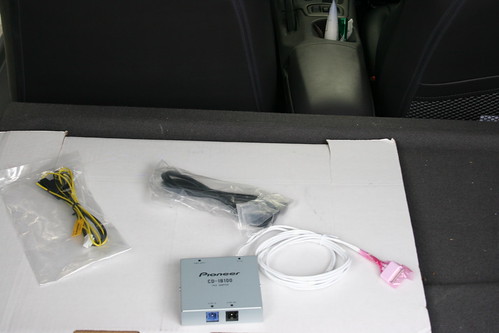
My big project this weekend was installing the Pioneer CD-IB100 iPod Adapter [flickr photoset] into my 2001 Toyota Celica.
A much more detailed writeup of my notes and comparison of other iPod options is in the extended entry. Part II will be the step by step instructions of the install.
Continue reading How-To: iPodding the Celica, Part I.
Today was my sister's graduation ceremony. I remember as a kid, watching the Cosby Show and seeing Theo graduate from college. The joke of that episode was that the school was so big that they had no moment of personal accomplish for Theo, no walk to the stage, just the simple act of "candidates rise", turn your tassels from one side to the other, "you're now graduated". That was my sister's graduation ceremony. Since she's getting a Master's, there's a little more than just standing up, and having your tassel turn from one side to the other -- the grad students stand up, and get "hooded" by the professors and then sit down. Before that moment is 1 1/2 hours of speeches by faculty and guest speakers (which I could sleep through). My point? Graduation ceremonies like the one depicted in The Cosby Show do exist, and they aren't myth.
I've also come to realize that Berkeley is ridiculously stingy about students entering the School of Business -- during my time there, they let only 125 students in per academic year -- while at SJSU they had more than 1000 graduate from that department.
Afterwards, we went out for dim sum, where I discovered my parents are incredibly demanding restaurant patrons. I also figured out that my bottomless pit of a stomach comes from my mother and my sense of taste comes from my father.
Meanwhile, my other sister is touring across Europe -- she just sent us an email from an internet cafe in Amsterdam and will be on her way to Switzerland tomorrow.
I love my parents, but at the same time, I can hardly wait for them to leave so that my sister and I can return to our normal lives...
Congratulations go to my sister, who just finished her Master's in Instructional Technology (Instructional Design and Media) at San Jose State.
I just came back from my sister's program banquet, where she also received a special award for Outstanding Student Portfolio.
Post-E3, some good info seems to be trickling in about these upcoming systems. What intrigues me the most seems to be the Technical Specs of the XBox 360 and Sony Playstation 3 -- they both use IBM Cell Processors running at 3.2Ghz, and come with specialized GPUs for processing the graphics. Hardware-wise, I'd say that the XBox 360 has an advantage over the PS3, and that gave developers would do well to place their bets on the XBox 360 as the platform to work on. It's hard to believe that these game consoles are so mindblowingly powerful and still cost less than a comparably equipped gamer PC.
Playstation 3 - Technical Specs Overview
XBox 360: Procedural Synthesis and Dynamic Worlds
Nintendo Revolution
XBox 360 vs Xbox
-
HotOrNot for Bunnies
-
Ingenious. An Umbrella built onto a lightsaber handle.
-
"The children. They've stolen their children!" - Indiana Jones
According to iPodLounge,
Toyota today announced that the 2006 Scion tC will receive the option of a Pioneer iPod adapter
. Total cost, including installation comes to be $260, about $10 more than BMW's iPod option.
th
I was actually doing some thinking this morning regarding my Celica iPod project. I already have a Pioneer headunit, so it should just be the matter of purchasing the Pioneer-iPod Adapter and installing it. The most difficult part of the install will be the mount for the iPod, which I haven't solved yet. Right now I've got a zany idea about an iPod dock, but I'll have to wait until I can get some measurements.
Canon and Lexar bugs cause lost pics on DSLRs
Since I have a 80x Pro Lexar CompactFlash Card and a 20D I guess I'll have to be careful, although since they don't elaborate, there's little I can do.
-
Darth Vader redeemed by his son...
-
If the Force is a Tool of Satan, does that make Lucas the Toolmaker?
One of the things I notice during my daily workday commute is how horrible of an exchange 101 South to 85 South has become since they "improved" it. The 101 is mainly a 4 lane highway and briefly becomes a 6-lane highway for the purpose of the exchange. Lane 5 is an 101 to 85 South exit-only lane, and Lane 6 is the 101 S on ramp from Shoreline which if you stay in will take you onto the 85 S. So it's usually here that one witnesses all sorts of automobile acrobatics (and accidents) as cars try to get onto the 101 and away from 85 or off the 85 and onto 101. Now, all of this wouldn't be too bad if there was decent distances to perform these lane changes, but I'd say there's a little less than 100 feet to do these things in.
-
I suspect that EA will insist on it being called: "SimEverything: Spore".
I just finished watching another viewing of Episode 3 with my co-workers, and I've come to the realization that how much one enjoys the movie is dependent on the mindset that one enters with.
A second viewing gives me an opportunity to separate the story from the technical details of film, and so I will present a spoiler free review in the extended.
Continue reading Episode III: Round 2!.
I just came back from watching a midnight showing of RotS (this entry is spoiler free), and I thoroughly enjoyed it. Thursday at work, I'll see it again, and I'll find out if it's as enjoyable in a repeat screening.
-
This has to be the most ergonomically unfriendly controller I've ever seen
-
The British tea market fell by 12 percent
Even though E3 hasn't officially started yet, the media machine is already rolling, with announcements of the Nintendo GameBoy Micro and the official specs for the Nintendo Revolution, XBox 360, and Playstation 3. Even Nokia joined the pre-E3 announcements game, stating that the N-Gage Platform is alive and kicking.
Tomorrow begins E3 in Los Angeles. E3 stands for the Electronic Entertainment Expo, which is the games industry's huge trade show that takes over the LA convention center for 3 days each May.
Having been to six E3's in the last 8 years, I decided that I could afford to skip this year's, even if so far, it does look like it will be one of the best, with the revealing of the 3 new next-generation consoles. Part of my reasoning for skipping the show this time around has to do with being jaded at what the games industry has become, and how E3 reflects that . While you do get to see a lot of great games in development and ready for the market, what you see a lot of the time are the same kinds of games.
Sequelitis and Copycat Games
I didn't join the games industry to make cookie cutter games, but more and more that is all that publishers are developing for the masses. As games get more expensive and as technology pushes the boundary between games and movies, publishers have become increasing risk-averse, and as a result, they are unwilling to invest money into a game that isn't a guaranteed best-seller. This, of course, explains why so many games are simply sequels instead of original game titles. At E3, one will find that the vast majority of games are sequels or games that could be sequels.
Media Badges
It used to be that the majority of companies had a "open booth" policy, meaning everyone was free to come take a look at their game. In more recent years, more and more showings of games have become "closed booth". Of course, when they said closed booth, what they really meant was "we want people with Media Badges to see our game, and the rest of you can go to hell". With the rise of the internet, most of these showings have now become "By Appointment Only", since
any kid with a game website can get a Media Badge now. On the plus side, since Media gets to view these games usually before attendees, I've actually found that the major websites cover the show pretty well, and much more indepth than I ever could.
Line-Waiting
One of the more recent trends at E3 is the small-venue theater-style presentation. Square was one of the first companies to do presentations in this style. Imagine a professional-grade home theater that seats 40 people. Now, imagine a presentation that takes 10 minutes to complete. Now, take into account that there are thousands of people at E3, and these booths become an exercise in line-waiting. Two years ago, the demonstration for Half-Life 2 was a 3 hour line.
Looping Movies
Every major company at the show has a booth with a huge TV, LCD, plasma, or LED movie screen showing a reel of their games (or rather their game cinematics) which loop repeatedly at deafening decibel levels. God help you if you happen to be next to Konami's booth (they have the hugest crowds typically for their cinematics) or EA (who have the loudest most sound obnoxious booth)
Tired Feet
After walking all day long at E3, lugging around a bag filled with literature from various companies, your feet and shoulders are sore and raw. With the exception of the small venue theaters, there are few occassions to sit down and rest.
There are, of course things that I will miss -- seeing the latest and greatest games, having the opportunity to dine in LA (not in the convention center), comparing notes on games after the show, getting free magazines and goodies, and playing Carcassonne in the hotel bar at night.
I'm sitting at home, watching the Steve McQueen classic "Bullitt", and it occurs to me that everything that seems old-fashioned in the movie was actually quite contemporary and modern when the movie was released in 1968. McQueen's San Francisco of 1968 is quite nearly unrecognizable to me.
37 years doesn't seem like a long time, but I find it fascinating that so much has changed. In the extended entry is a list of things that I found were modern for the time that you don't really see anymore.
Continue reading Bullitt.
-
Who needs a geneticist? Build your own DNA lab.
-
I'm guessing the teen got a new one after the explosion.
Animators sometimes go a little nuts after working on cinematics, and when that happens, you get things like this:
http://jpn01.konami.co.jp/movie/mgs3/movie_1_snake_e.swf
http://jpn01.konami.co.jp/movie/mgs3/movie_2_bomb_e.swf
http://jpn01.konami.co.jp/movie/mgs3/movie_3_sokolov_e.swf
http://jpn01.konami.co.jp/movie/mgs3/movie_4_hands_e.swf
http://jpn01.konami.co.jp/movie/mgs3/movie_5_gokai_e.swf
http://jpn01.konami.co.jp/movie/mgs3/movie_6_lastbattle_e.swf
http://jpn01.konami.co.jp/movie/mgs3/movie_7_joy_e.swf
http://jpn01.konami.co.jp/movie/mgs3/movie_8_sabra_e.swf
http://jpn01.konami.co.jp/movie/mgs3/movie_9_mgs_e.swf
http://jpn01.konami.co.jp/movie/mgs3/movie_a_gekitotsu_e.swf
"There are two ends to any lightsaber -- one end has the belt ring, while the other end houses the blade arc tip and blade emitter. NEVER point the blade emitter of a lightsaber toward your own body. NEVER look down the "barrel" of a lightsaber, even if you are "sure" it is in safe mode. If you accidentally activate the lightsaber, serious injury could result."
-
The animation for this video is fantastic, despite the usage of CG.
-
Architectural review of a Memorial to the Murdered Jews of Europe
-
Stephen Colbert gets his own show
-
How the movie industry is influenced by comic books
In May of 2002, I attended a sneak peek charity screening of Star Wars Episode II: Attack of the Clones. The ticket cost about $400 dollars, most of which was tax deductible. The charity that received the proceeds was one in education, and the two theaters worth of attendees raised somewhere around 300,000 dollars. I also received a grab bag of Star Wars related merchandise, treated to All-You-Can-Eat In-N-Out prior to the showing and a lavish gala premiere party afterwards (where it was basically an all-you-can-eat buffet bar with free wine). Several San Francisco luminaries were there, as was George Lucas.
Since that time, I've been keeping a tighter watch of my finances, but I still found myself looking on TheForce.Net to see if there would be any charity screenings around for this, the final big-screen chapter in the Star Wars Saga.
It turns out that there will be charity premiere screenings, but glancing at the site selling the tickets, even for a techie like me, the price of the tickets would be considered too extravagant. In comparing the SF showing I attended to the LA showing, I feel like I received a bargain in SF 3 years ago, as the meet and greet was with Lucas rather than a minor character who has one line in ESB (and it was $1100 cheaper!)
-
The Berkeley Art Museum is showing many Studio Ghibli works on the big screen (some shows free)
-
The artists do the work, but the Warner reaps the profits.

For Christmas last year, my sisters got me a Roomba Discovery, but I wasn't able to go home and retrieve it until this past weekend. Already it has made me pick things off the floor, and ordered me to go out and purchase some AA and D batteries tomorrow.
It looks like I'm not the only one who notices a dearth of creative titles being brought to market. John C. Dvorak writes about the future of games in a recent PC magazine article, and he comes to the conclusion of a doomed industry which doesn't offer anything new. I disagree with a lot of his points and while one can point as hardware being the driving force, it's more than that.
The games industry is not only driven by the hardware side of the equation, but also by the software side. And software development is driven by the publishers. The publishers decide what to produce, and what will receive marketing muscle and what types of games will make the most profit. Games these days seem fresh from the cookie cutter, but that's because the business model wants proven titles. As games get more photorealistic, the cost to make these games rises dramatically. In the past, it was possible to produce a game on a shoestring budget, but the cost of making a game now rivals making a movie. And now that it requires such a large sum of money, few people are willing to invest that much unless they are assured of it's ability to turn a profit. They want safe bets. Creativity is a high risk bet.
Dvorak uses Spider Solitaire as an example of a game that one can casually play without being burdened by hardcore gamer elements, but some people can't stand Spider Solitaire. For me, the idea of shuffling cards around stacks in order is just a little too much like "Towers of Hanoi" to be any fun.
There are creative games out there, but they are not produced by the big publishing companies. Instead they are little niche games which you don't need to be a hardcore gamer to enjoy, but someone has to tell you about them, because you're probably not going to find them sitting in the endcaps of BestBuy or Gamestop.
A couple of gems:
Phantom Dust, a $20 dollar XBox game, it combines the strategy involved in collectible card games with a 3rd person perspective destroyable environment.
Insaniquarium, a Java based action-puzzle game.
Puzzle Pirates, a MMOG for the casual gamer
I haven't said too much regarding IP or video games of late, but these days it's increasingly important to own your own intellectual property (IP) in the games industry as a third-party developer.
The way games work is that if you have a development team developing your own title, you want to own your IP. The reason is because publishers are flaky and can cancel a project at any time. If that happens, you don't want to be without the IP that you spent years creating.
Let's just say for a moment that you are the owner of a games studio, and a big publisher approaches you for a buyout of everything the company owns, including all the IP rights for all the games this studio has ever created. If you sell, you get the big cash payout of whatever they pay for the company. But in buying your IP rights, they also have the ability to make whatever games and merchandising they want out of your IP without needing to pay you a single cent. Even if you created the IP initially, it is now owned completely by the publisher. Sometimes you can buy back your IP rights if you've negotiated them away, but it's increasingly important to retain them at any cost, because the IP gives you the flexibility to take what you've made and really write your own ticket.
Valve is the company behind the very successful Half-Life series of computer games. In 1997, Valve signed an agreement with Vivendi Universal for broad distribution and manufacturing rights of the games. In 2001, Valve and Vivendi ammended those rights by giving back the intellectual property rights and online distribution rights back to Valve. In 2002, Valve sued Vivendi Universal for licensing Half-Life titles to cybercafes for a licensing fee, claiming that it was in violation of Valve's online distribution rights. In November of last year, a judge barred Vivendi from distributing Valve titles, pending legal outcomes of the suit.
Vivendi Universal doesn't own many cash cows. For years at Blizzard, we joked that the only thing keeping Sierra alive and profittable was Valve and their Half-Life titles. The other revenue source for Vivendi is primarily Blizzard Entertainment, and all of that money is now coming from non-WoW games. Although I don't have any numbers pertaining to WoW, my own personal estimate of the development costs and resources involved to maintain WoW is that it will be some time before WoW can turn a profit.
A few days ago, Settlement of Valve vs. Vivendi lawsuit was announced, with the following statement in the press release:
"Bellevue, WA and Los Angeles, CA - April 29, 2005 -- Valve and Vivendi Universal Games (VU Games) today announced the settlement of a pending federal court lawsuit filed by Valve in August 2002. The parties have resolved their differences, and the settlement provides for the dismissal of all claims and counterclaims. Under the settlement agreement, VU Games will cease distribution of retail packaged versions of Valve's games, including Half-Life�, Half-Life 2, Counter-Strike�, Counter-Strike: Condition Zero and Counter-Strike: Source, effective August 31, 2005.
Additionally, VU Games has notified distributors and cyber caf�s that were licensed by VU Games that only Valve is authorized to distribute Valve games to cyber caf�s and grant cyber caf� licenses. Cyber caf� operators that were licensed by VU Games have also been notified that any license agreement from Sierra Entertainment, Vivendi Universal Games or any of their affiliates or distributors that may have granted rights to use Valve games in cyber caf�s, whether written or oral, is terminated."
In short, Valve got everything they wanted and Vivendi loses a very golden goose. Ceasing distribution of retail and boxed versions of the Half-Life franchise is huge -- that opens the possibility of Valve self-publishing (which they currently do to a small extent) or renegotiating their publishing agreement to better terms to a different publishing company. More importantly, by cutting out the publisher, they take the whole pot, rather than pennies from the pot.
A month ago, I went to get fitted for a tuxedo for a friend's wedding at After Hours Formal Wear. He specifically chose After Hours Formal Wear because they are a nationwide chain, and because they had locations in Northern California, saving me a trip down to Southern California in order to get fitted. The measuring and fitting took probably ten minutes tops at the Santa Clara store, and I figured it'd be easier to pick up the tux at Mission Viejo (where the wedding was registered) than it would be to pick it up at Santa Clara, drag the tux down to Southern California and return it to the Santa Clara store, and they told me it would be no problem, and I watched as they faxed the order through to Mission Viejo. Fast forward to two days before the wedding, when I and the groom go down to Mission Viejo to pick up our tuxedos. No problem with the groom's tux. It's there, it's ready and it fits. My tuxedo on the other hand... isn't there. In fact, the order isn't there. They have no record of me. They call the Santa Clara store to see if it had arrived there instead. It's not there. They try the Aliso Viejo store and it's also not there. My tuxedo is lost somewhere in limbo, if it exists at all. This is all made worse by the fact that the clerk that is helping the groom and I is a 60+ year old man with a thick European accent whose eyes are going bad. He misread my last name several times and confused a 408 for 808. "The phone number isn't in service", he declares. You wrote the number down wrong, i explain, and show him that the Santa Clara store is area code 408 not 808. I explain to him multiple times that the wedding is registered at the Mission Viejo store, he pulls out a thick 3 ring binder, flips through it and says "No, the wedding isn't registered here". The bride was ready to berserker, unpleasantly drag him into a corner and pummel him into his next incarnation when she heard these words come of his mouth.
An hour has passed since the entry into this store. The groom is done checking the fitting and has been waiting for some time to get this mess sorted out. The solution is simply to write another sales order and they assure me that by the next day at noon, the tuxedo and all the fittings will be there ready to pick up.
I arrive at the store after our wedding rehearsal the next day to find out that the tuxedo isn't there. It's at a different store -- the Aliso Viejo store. Luckily the store is close by and I can drive there to pick it up. When I get there, I find out that had it not been for a clerk at the Aliso Viejo store who noticed that the suit didn't belong there and called Mission Viejo, Mission Viejo never would have known it was at the Aliso Viejo store.
I'm cutting out a lot of pain and agony out of the retelling of the story, because there are some things that just can't be described without experiencing.
After Hours formal wear is completely inefficient.
You see, it turns out that After Hours Formal Wear suffers from 1980s technology syndrome. They fill out carbon paper based forms instead of web-based forms, and they file paperwork alphabetically instead of inputing that data into a searchable database. Pulling up orders consists of flipping through a 3-ring binder, and these people still use fax machines to transfer orders from store to store instead of using a networked nationwide computer system. Which may actually work in After Hours seeing as how most of the sales staff was completely computer illiterate. There was a computer there, which sat more like a decoration than anything else. They tried Control-Tab and Shift-Tab before finding Alt-Tab to do application switching.
I've never seen such inefficiency in my life.
So, long story short. Don't use After Hours Formal Wear unless you must and avoid the Mission Viejo store in particular at all costs.