-
Kindle, Disassembled.
November 2007 Archives
 This picture is a campaign flyer for Childhood Obesity Awareness Campaign. Childhood obesity is a problem -- in addition to getting made fun of and bullied by their classmates, fat kids stay at home sitting on the couch with an upside down XBox 360 staring into space while holding an XBox 360 controller that's plugged into nothing. Last time I checked, XBox360 controllers plug into the front of the XBox 360, not the back. Not only that, but this particular obese child also doesn't realize that XBox 360 is plugged into nothing. Of course, this photo is also highly inaccurate because the sofa is much too clean -- if we are to believe that this child does nothing but sit on the couch, eat his chips and soda and can't be bothered to plug in his damn game system, there should also be residual crumbs and leftover food wrappers decorating the premises. Being so tidy, it feels like this photograph was taken in an IKEA showroom. Of course this particular kid gets to be a model for a high exposure campaign against obesity -- that's gotta score some valuable rep points on the playground on Monday morning.
With a little over a month to go on MacWorld 2008, speculation has already started about what Apple will choose to reveal at the Apple-centered conference in mid-January. The top contender is an ultra-portable MacBook. In fact, since December of 2005, the rumor of a Mac ultra-portable has been on analysts predicition lists, but has never materialized at MacWorld.
With a completely new lineup of iPods having just been announced in September, it is highly unlikely for Apple to make any new announcement of iPod related products at MW2008.
In June of 2005, Apple announced the transition to Intel. In January of 2006, Apple moved their first computers to Intel with the MacBook Pro and the iMac. This announcement led to consumer frustration from those who had purchased new computers the previous holiday season, and in January of 2007, MacWorld came and went without announcements of new computers or new iPods, and instead focused on introducing new products. Such a strategy does open up the possibility for new computer types, such as the Mac mini (which was announced at MacWorld 2005) as well as completely new device types, such as the Apple TV and the iPhone (both premiered at MacWorld 2007).
One thing which hasn't seen a lot of coverage at MacWorld has been Apple's iTunes service -- they've instead chosen smaller venues to coincide with announcements about new product offerings on iTunes, but I believe that MacWorld 2008 might see the announcement of Apple's iTunes media rental service (which has already been revealed as a future possibility within iTunes). The release of an official iPhone development kit in February also lends some validity to this theory, as you would not want developers stumbling across this feature and confirming such functionality before an official announcement could be made. A video rental service would also provide a boost to Apple's lagging Apple TV product.
There are some that predict that MacWorld 2008 will unveil a 3G iPhone. While I definitely believe that to be a possibility, I think that such a product is already expected and will not make the kind of impact that Steve Jobs and Apple usually like to have in a keynote announcement. At the same time, I can't help feeling that MacWorld 2008 will be the MacWorld of the iPhone, so maybe an expansion of the iPhone line-up with a smaller cheaper iPhone? The possibility of this ties in perfectly with the release of the iPhone SDK in February.
The big news this morning is that Google has announced that they will take part in the bidding process for the 700 mHz wireless spectrum in the United States. In order to bid, they must file an application with the FCC by the deadline, which is this Monday. Google is interested in the C-block of the spectrum, which currently carries a reserve price of 4.6 billion.
As part of the auction, the FCC has made "open access provisions" part of the C-block of the spectrum, mandating that the auction winner "shall not deny, limit, or restrict the ability of their customers to use the devices and applications of their choice..." and that "no licensee may disable features on handsets it provides to customers....", all of which means that someone like Verizon, who is notorious for locking down and deactivating certain features of phones on their network isn't going to bid on the spectrum. If the reserve price isn't met, then the spectrum goes up for auction again, this time without the open access provisions. With Google bidding, at the very least the spectrum will make the reserve price, and open access provisions will be in effect.
Chairman Eric Schmidt has stated in a press release:
"We believe it's important to put our money where our principles are. Consumers deserve more competition and innovation than they have in today's wireless world. No matter which bidder ultimately prevails, the real winners of this auction are American consumers who likely will see more choices than ever before in how they access the Internet."
Looking at the big picture, if Google wins the license for the spectrum, Google could become a provider of mobile phone and internet services, and it could also partner with or lease the spectrum to those who are interested. With their recently created Open Handset Alliance, they will soon have phones which will run on their Mobile Platform. Google, doesn't intend on becoming a carrier like Verizon or Sprint, and I believe if they were to become a carrier, their services, much like their software products, would be available for free, and likely supported by ads.
Google has thus far, done an excellent job of destroying paid service models -- before Gmail, users of MSN and Yahoo! Mail happily forked over cash for more mail storage, and I find myself working more on Google Documents than I do within Microsoft Office. I think what will happen with OHA and Google will be a variety of handsets that will provide the user control of their phone, in ways that previously was limited to those with more technical expertise. For instance, cellphone content are still an item that consumers spend millions on per year -- what Google could have is a pipeline to deliver that content -- even if Google does not win the bid, they will have at least met the reserve price to open up the spectrum for the open access provisions to go into effect.
-
What happens when you find wikipedia on the menu at a restaurant in Beijing?
Last year, when I went to Japan, we visited Roppongi and saw this giant sculpture of a spider.



Since War of the Worlds had been released the previous year, I overheard people who believed that perhaps this was a movie tie-in. I knew this probably wasn't the case as Martian war machines have three legs, but I took photographs of the sculpture, and then forgot about it, until I recently saw this photo taken in London:

Thirty-five foot tall spiders made out of bronze aren't something you see everyday, but this time I had more information. The work is called "Maman", and the original one made out of stainless steel is located at the Tate museum at London. The sculptor is Louise Bourgeois, and there are six bronze full-size castings of her work located at:
- National Gallery of Canada, Ottawa
- State Hermitage Museum, St. Petersburg
- Guggenheim Museum Bilbao
- Mori Art Museum, Roppongi, Tokyo
- Samsung Museum of Modern Art, Seoul
- Havana, Cuba
Now, the last time I was in San Francisco, we drove by the Embarcadero, and I noticed a smaller spider done in the same style. The one in San Francisco is not "Maman", but the smaller "Crouching Spider" done by the same artist.
One of the things I've been thinking about has been that of this year's "Most Wanted" Products.
- Nintendo Wii
It's been more than an year, and the Nintendo Wii is still flying off the shelves, and still as difficult as it was a year ago to find. Why is it so hard to find one this holiday season? Because while a normal product cycle has Nintendo stockpiling supplies beginning in August, this year's sales of the Wii has had the Nintendo warehouses empty of console units, as retail orders were filled. Nintendo games like Metroid Prime 3: Corruption and Super Mario Galaxy definitely helped the new console's game library, which, prior to this year consisted of few "must-have" games.
- iPhone
While there's some discussion of a new 3G iPhone on the way in 2008 , this should not be a surprise -- there's always a newer phone, and a newer product due from Apple, but this version 1.0 product has quickly become one of the most talked about products of the year. I know of no other product this year that had people lining up for days in advance, in order to own the iPhone. When Apple announced the iPod Touch, which looked very similar to the iPhone in terms of shape and size, I wondered if the iPod Touch would cannibalize sales of the iPhone. Amazingly, it seems that while the iPod Touch is a beautiful device, people would rather have an iPhone (and have the added camera and phone capabilities), while the iPod nano seems to be doing a pretty good job of selling to the masses.
- Amazon's Kindle
Though I don't see the appeal of the Kindle, the new portable e-reader made waves last week when it was announced, and sold out in a few hours. I can see this device being good for a business traveler, or someone on the go, but without a larger selection of books available along with a better display and tactile feel to the device, it's not a product that I can recommend at this time.
Too funny. There's a ton of WoW in-jokes in the song lyrics.
Pokemon Pan as in "bread", not as in Pokemon Cake Pan.
-
The full text of Rainbow's End by Vernor Vinge

New Star Wars Series 2 Mimobots, shipping in January/February. 49.95 for 1GB, 69.95 for 2GB, and 109.95 for 4GB. Some of these new ones have helmets that reveal a painted face underneath.
-
... Just eyeballing it, I'd say this guy definitely blew more than 35 grand on all that stuff.
-
An interview with Kristin Sloan, the ballerina-blogger in the iPhone Ad, "The Winger"
-
Why pay for Amazon's DRM locked files, when you have Manybooks for free?
-
Free e-book: Trigger Happy by Steven Poole, a book about videogames, released under Creative Commons.
-
You buy land, you pay taxes on the land, and now you're buildng your retirement home on the land when your neighbor declares the land to be his because you haven't used it in while. A strange case that feels a little suspicious.
-
Carmack about Apple and Games.
-
Some pretty radical ideas here about an e-book reader.
-
The present is crazier than the future that he could have imagined.
-
It sounds cool, but them you look at the actual video and it looks really lame.
I don't know what's been afflicting me, but I just can't stop talking about the Kindle, Amazon's new e-book reader. Maybe it's because I want it to die a spectacular death, since I don't want my book buying experiences for the rest of my life to be done on the Kindle.
I do find one thing to be of particular value on the Kindle, which also might be the sole reason for purchasing one: EVDO for free. EVDO is a wireless standard that is used on cellphone networks to transmit data. Currently, to get unlimited EVDO service on Sprint, it costs about $60 a month.
The Kindle is a standalone device, meaning that it doesn't require a computer, but it does, like many other cellphones, use a USB 2.0 for transfering larger blocks of data. I suspect that with a small number of Kindles having been delivered to the American public, it probably won't be long before it's torn apart, and someone figures out how to make the Kindle to act as a wireless access point.
Mr. T as a Night Elf Mohawk (Warrior)
Shatner is a Shaman:
-
I used to think that Senators were pretty important people, but it turns out they spend all that time in Congress discussing issues like "Should Manhunt be M or AO?" With all the press coverage on Manhunt's rating, one wonders if they're being paid to do
Apparently, myself and the rest of the tech world that slammed the Kindle for being essentially a portable Amazon storefront, were way wrong when it came to the Kindle -- people are willing to part with $400 for a Kindle, because Amazon's stock of Kindles has apparently sold out in less than six hours.
Of course, we don't know how many were in that stock, but the relative availability of the Kindle (more to be shipped out next week on 11/29) suggests that this initial stock was meant to be large enough for some people to say "I got my Kindle!" while still producing a good number of hours for selling out. There's no incentive for Amazon to have a large amount ready to ship on announcement -- the way Amazon works, someone's not likely to cancel an order just because they have to wait a week for it -- no one else is going to sell Kindles except Amazon. They just need that number to be large enough such that if someone does ask how many they sold on the first day, it's not something ridiculous like 10.
I assume the initial stock was extremely limited, perhaps no more than 10,000 units. This is Amazon we are talking about here -- the company that sells out of their Wiis in a few minutes. 10,000 is a respectable number -- it's a large enough number that Amazon can say "That's all that we could have in time for the announcement", and it's small enough to say "We sold out of them in a few days". The fact that they sold out in 6 hours suggests that the inital allotment may be even less than 10,000 units. My own personal guess to the number is in the range between one and three thousand. If we work backwards from Nintendo's example, they sold 600,000 Wiis in a week, which becomes about 1 Wii sold per second. Even if Amazon were to sell 1 Kindle every second, that calculates into -- 1 x 60 x 60 x 5 = 1,800.
I love books, but when I logged onto Amazon yesterday morning and saw the announcement on the front page, my initial reaction was not to click the "Buy Now" button, but to read more about it. People have been saying that it's the iPod for books, but that's not accurate, because of the one big difference. The iPod never asked me to buy a whole new music library for my device. All the CDs I had didn't suddenly not exist to the iPod. The Kindle is asking you to pretend your book library doesn't exist. If you want your book on the Kindle, be prepared to shell out some money to have a digital copy of the book.
What I'd like to see implemented on Amazon is that they make available digitally any book I purchase physically. Give me an incentive to buy a Kindle, and to read my books on it. My physical book library will long outlast the Kindle's lifetime, and probably my own lifetime.
Cory Doctorow of Boing Boing had this to say regarding the Kindle:
Here's the biggest mystery of the Internetiverse for me today: why is it that Amazon, the most customer-focused, user-friendly company in the world of physical goods, always makes a complete balls-up hash out of digital delivery of goods? You'd think that they'd be the smartest people around when it comes to using the Internet to sell you stuff you want, but as soon as that stuff is digital, they go from customer-driven angels to grabby, EULA-toting horrors. Why does the Web make Amazon go crazy?
This mystery is definitely something that's been on my mind -- Amazon has been great to me for buying books and other items -- I'll gladly plunk down 2 or 3 grand for a new camera, but when it comes to digital media, Amazon has yet to earn a single penny from me, and part of that is due to the feeling that something that exists purely as a DRM-locked digital file isn't permanent enough. That being said, the field of e-books is a frontier yet to be explored, but I've yet to see a system that works. This is a good try at trying to re-invorate the market, but I suspect that the winner of this will be someone who can make the experience more like a real book and less like a giant PDA.
 Amazon has just launched their Kindle e-book reader. Sporting a display of 6 inches with 167 ppi of electronic paper (e-paper) resolution, and weighting just 10.3 ounces (about the size of a small paperback book), it features both Wi-Fi and has a built-in EVDO modem.
The EVDO modem utilizes the cellphone network so that hunting for a Wi-Fi hotspot isn't necessary, making books available to purchase anytime you can get reception from the Sprint network. Despite the fact that it uses Sprint, there's no fees and no contract for using the wireless network. Can you surf the web on it? Yes. Can you e-mail from it? Yes, for 10 cents per e-mail.
The design of the device feels a mite unfriendly (and ugly) to me, with the buttons for next and last page mounted on large buttons on the sides of the device, I feel that you're essentially holding the Kindle at the bottom of the device, rather than the middle, which I believe may be problematic. The keyboard is a good idea, but I feel the keyboard should have been hidden in a sliding design, as the only time you need it is a small percentage to the main function of the device, to read books.
Keeping in mind that this device is released by Amazon, their motivation for releasing this device is pretty clear: they want to sell you reading material. Despite the free wireless service, putting anything on this device has a cost associated with it. Unless otherwise marked, all New York Times bestsellers and new releases are 9.99 or less, and magazines and newspaper subscriptions are reasonably priced and are priced on a monthly basis such as the New York Times for 13.99 a month, and TIME for 1.49 a month. Since the new media publisher is the internet, high volume blogs like Boing Boing are also available on Kindle for 1.99 a month. While I read Boing Boing daily, much of their content is based on providing links to other sources, and I'm curious if being part of Amazon's subscription is going to change their style of writing up articles. Content being offered for Kindle of course, provides another alternate revenue stream for bloggers and authors.
While I think the Kindle e-book reader is a revolutionary new attempt at e-books, it falls a little short of being a book replacement for me, for a number of reasons. The price of the reader is $399.99, and while that's as much as an iPhone, it does depend on multiple pieces of technology that may or may not exist in the years to come.
- EVDO network. Sure, it's currently one of the standards that we're using, but what happens when that technology is phased out?
- The Kindle and Amazon.com. The Kindle has a number of features locked into Amazon, including how to buy, download and store purchases. Lose your e-reader? Not a problem, as all the books are kept in your Amazon media library and available for download.. However, your e-books are at the mercy of Amazon -- should they decide to switch data formats or discontinue the Kindle program, you could end up with an largely unsupported device.
While I don't mind paying for new books, with the Kindle you can't really loan them out like you can do with a physical book. You can't re-sell them like normal books either. The prices for paperbacks are similar to new prices of paperbacks, meaning that old books like Snow Crash is priced at a somewhat mind-staggering $7.96, a $2.24 difference from Amazon's current retail price of 10.20 (my physical copy of Snow Crash cost me 5.99 in 1993, and will still be usable until the paper of the book disintegrates) while something really old like Foundation is $3.99.
The big worry on my mind is obsolescence -- while one would assume that should the Kindle program succeed, newer, faster, better e-readers would be on the horizon, and essentially you're paying $400 for an e-book reader that might be replaced in a few years. Which leads me into the ecological impact of e-books. On one hand, they save paper, but each e-book reader also generates an amount of dangerous e-waste in the process of manufacturing and disposal, and books decompose with less ecological impact, as most of the material will just naturally breakdown. The plastic case and the circuit boards shouldn't be disposed of in the garbage, but I'd say that a small proportion of them will still end up there, unless Amazon has a trade-in/used program for the future.
The applications for Kindle I see mostly using it for would be, interestingly enough, the things that they don't have on the device yet -- maps and photographs/graphics, both of which would require much higher storage capacity. I can see this being useful for educational purposes -- provided that a future Kindle would have color and graphics, you could have all your textbooks on one device, in much the same way that an iPod allows people to contain their entire music collection in their pocket.
It's a good idea, however, I feel that the initial implementation isn't polished enough. Time will tell if this is the future of e-books or just another electronic novelty.
-
Don't forget to chip your animals.
-
I always joke about Google Brain (gBrain) but maybe it'll be Microsoft Brain instead...
-
April? That's such a long time away (sniff)
-
As soon as we saw the previews for Beowulf, we all screamed "Uncanny Valley" as being the major problem for the film. Part of me still wonders why they didn't just film the actors if they are going to use their likeness.
-
Multi-player and co-op. I always wanted to be a Ghostbuster.
-
What would it take for you to sell out your right to vote? For 1 in 5 NYU students, that vote is only worth an iPod touch.
-
...because it means they need to either take down Google or Yahoo! Given Microsoft's animosity for a certain bay area search engine company, you can guess which one they want to knock down.
-
Book Covers of 2007
 I am notoriously bad at matching names to faces. Anyone watching a movie with me will vouch for this, as whenever a person comes on the screen that looks familiar to me, I'll say "Hey, isn't that (some actor)," and the people in the room will look at me with puzzled looks on their faces and say "Huh? They look nothing alike. No, that's (some other actor)." In Hollywood especially, I find that faces more or less all look same. For years, I could not tell the difference between Al Pacino from Robert De Niro (thankfully, it's gotten better as they've gotten older, as Pacino grows more gaunt and wrinkled, while De Niro goes bearded).
I present a photo of the Beowulf premiere that finds that Getty Images sucks as much as I do in identifying people. The description of the image reads as follows:
Beowulf Premiere - Inside
LONDON - NOVEMBER 11: (EMBARGOED FOR PUBLICATION IN UK TABLOID NEWSPAPERS UNTIL 48 HOURS AFTER CREATE DATE AND TIME) Crispin Glover and Sir Anthony Hopkins attend the European premiere of 'Beowulf', at the Vue West End on November 11, 2007 in London, England. (Photo by Dave M. Benett/Getty Images)
Yes, that's Sir Anthony Hopkins. The man standing beside him, however, is not Crispin Glover (Thin Man in Charlie's Angels, George McFly in Back to the Future), but rather writer Neil Gaiman.
If memory serves, in Empire Strikes Back, Chewbacca served as a pack mule, carrying the destined interpretor for Jabba the Hutt and future deity to the furry Ewoks on his back as they made their escape from Bespin, and now you can relive the adventure, with the mighty Chewbacca backpack, which, unlike the Yoda Backpack, doesn't really fit into the Star Wars continuity (or maybe it does in the Expanded Universe, or in Han x Chewbacca slashfic somewhere). While I can't imagine anyone of school age not getting beat up for wearing this or being the target of jokes (remember, Leia would rather kiss a Wookie), there's something deeply unnerving about unzipping Chewie's backside to shove books inside.

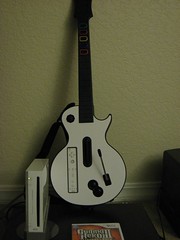 When I plugged in Guitar Hero III into the Wii a few weeks ago, I started career mode on easy, and instantly I felt challenged. Now, let me be clear, I am not a good Guitar Hero player, I can barely get past the first set on Guitar Hero II on the medium difficulty level, but on Guitar Hero III I can't even pass a single song on medium.
Part of the background about Guitar Hero III is that the original developers Harmonix left that franchise to Neversoft, a new group of developers, and Harmonix started working on Rock Band. Now, from a game player aspect, I definitely enjoyed playing the songs on GH2 much more than on GH3, but I was never a fan of classic and metal rock of the 70s era, and I blame the Neversoft developers (who probably do enjoy that type of music) for picking a ho-hum playlist of songs. In the end credits for GH3, photos of the Neversoft developers appear, and they all appear to be middle-aged balding men of the right age to enjoy the classic rock oldies that make up the bulk of GH3. Sadly there's not many songs on the unlockables that I find interesting.
Interestingly enough, there are songs that appear on both Guitar Hero 3 and Rock Band, and Games Radar did a side by side comparison of their difficulty.
 Mr. Magorium's Wonder Emporium is one of the films I plan on seeing this winter, not just because it has Natalie Portman and Dustin Hoffman in it, but because it's got Holiday Kid's Movie written all over it.
In a Holiday Toy Drive last week, they've also managed to raise an auspicious 28808 pounds of toys for Toys for Tots.
I wish I could say that I've had a productive day, but I haven't really. You see, I've been watching the woot-off on woot. I'm alright on the general concept of woot! -- I look at what special item they're selling at 10 pst, and then figure out if it's something I need/want, and then I move on with my life. Woot-offs, however, appeal to my obsessive-compulsive nature -- as soon as one item sells out, the next one is brought forth like the next gladiator in the Coliseum, until the woot-off is finished. Woot is, for the most part, an easy way for me to get new/refurbished parts for whatever make-it-yourself project I'm working on, but today's woot-off has been sorely lacking in useful materials (unless I was building some kind of telephony/audio/headphone project).They've had two Zune items which took forever to sell out of (I guess wooters aren't zuners), but not a whole lot of useful bits to take apart and disassemble. I suppose I should be thankful that the woot-off has stalled; otherwise, when would I get around to writing entries like these?
In a Daily Show-esque report about the writer's strike, I can imagine this is similar to what Jon Stewart would be saying if the writers were still writing the jokes for the Daily Show:

This Apocalyptic Manhattan built by gamer oimorrigan takes up 3 rooms in an apartment, and was built for Warhammer 40K. They used casting, foamboard and construction plaster to create the damaged buildings.
Link (via Boingboing)
There's really one one electronics store that I refuse to buy anything from -- Best Buy. While I have a mild distaste for Fry's (mainly because 50% of their for sale stock is stuff that has been previously returned), I despise Best Buy because they have shown time and time again that they are incredibly sleazy and hostile towards their customers. The latest story is on a particular Best Buy in NJ selling "the last Wii" over and over again:
"I was standing near the back of the store when one of their salespeople came strolling from a back door holding a Nintendo Wii over his head, and started walking the aisles announcing that it was their last unit. I followed, wondering both how quickly would it get snatched up and how quickly could I decide if I wanted to buy it. It took a few minutes for a couple to come rushing up to claim it, exclaiming how happy their kids were going to be. I went back to looking around the store. About 30 minutes later, I heard this announcement on the store's PA: "Attention Best Buy customers! Julie is now walking through the store with our last Nintendo Wii! If you're looking for a Nintendo Wii, please look for Julie!" And there was another salesperson doing the same thing as the first - walking the aisles of the store holding the Wii above her head."
In addition, Best Buy has been caught before with charing more for an opened item than a new item, outright lying to their customers, and using a in-store website that showed different prices than their online website. They're just a terrible place to do business with, and they won't be getting my money for a long, long time.
Way back in June, John Scalzi posts about how the creation museum opened up down the street from from him, and how he refuses to visit. This of course, incited one particular reader of his blog who said that
"Scalzi should not be allowed to get off so easily. The Whatever Community needs to rise up and DEMAND he pay a visit to this important cultural center ASAP. In fact, we need to give him an irresistible reason to go. Here's my idea: not only will I pay the price of the Scalzi family tickets to the Creation museum, I will donate an amount matching the price of those tickets to the charity of John's choice... but only AFTER he files a comprehensive report about his visit on the Whatever.
Are there any other Whatever readers willing to make a modest donation to a Scalzish charity to compel a Creation Museum visit? C'mon, let's pass the digital hat. Who's in????!?!?!"
which followed in a counter by Scalzi, who put his going price by raising $250 by the end of the week to force a visit.
I will go to the Creation Museum and file a full, detailed and delightfully snarklicious report of the trip IF AND ONLY IF I receive at least $250 in donations via PayPal by 11:59pm NEXT FRIDAY, June 15, 2007. ALL the proceeds (minus PayPal's processing bite) will then be donated to Americans United for Separation of Church and State, an organization which for sixty years has striven to keep the chunky peanut butter of religion out of the dusky chocolate of good government.
Not only did the donations hit the $250 mark, it raised 256 times that amount, $5,118.36 to be exact. True to his word,
Scalzi then wrote a full report of his tour, complete with commentary and photographs , including gems like this one about dinosaurs being in the museum:
Are dinosaurs 65 million years old? As if -" the Earth is just six thousand years old, pal! Dinosaurs were in the garden of Eden -" and vegetarians, at least until the fall, so thanks there, Adam. They were still around as late as the mid-third millenium BC; they were hanging with the Sumerians and the Egyptians (or, well, could have). All those fossils? Laid down by the Noah-s Flood, my friends. Which is not to say there weren-t dinosaurs on the Ark. No, the Bible says all kinds of land animals were on the boat, and dinosaurs are a subset of "all kinds." They were there, scaring the crap out of the mammals, probably. Why did they die off after the flood? Well, who can say. Once the flood-s done, the Creation Museum doesn-t seem to care too much about what comes next; we-re in historical times then, you see, and that-s all Exodus through Deuteronomy, ie., someone else-s problem.
But seriously, the ability to just come out and put on a placard that the Jurassic era is temporally contiguous with the Fifth Dynasty of the Old Kingdom of Egypt -" well, there-s a word for that, and that word is chutzpah. Because, look, that-s something you really have to sell if you want anyone to buy it. It-s one thing to say to people that God directly created the dinosaurs and that they lived in the Garden of Eden. It-s another thing to suggest they lived long enough to harass the Minoans, and do it with a straight face.
A recent poll found that 43% of parents don't play video games with their kids who do, and the media is going crazy about these numbers. Not because 57% of parents DO play videogames with their kids, but because these 43% of parents don't know what their children are playing, don't know what they're being exposed to, and don't know what they might be learning from them, and this scares people. If you're a parent, you basically have two options:
- Option 1: Start playing videogames with your kid.
- Option 2: Take away your kid's videogame console.
Of these two choices, I feel that option 1 is the better of the two, and not just because the media loves stories about violent acts that happen when videogames are taken away, but because I feel that option 2 ostracizes the child from their friends who probably play. When 81 percent of children age 4 to 17 play videogames at least occasionally, parents need to realize that videogames are a piece of childhood just like owning a pet, birthday parties and sleepovers. That's not to say that videogames should be "unlimited play" -- there will be times when your child will want to play, and it's up to the parent to say "no" or to place restrictions on the child. That is, quite simply, part of the job of being a parent.
Furthermore, I believe that option 1 has bonding possibilities, while option 2 just opens possibilities for conflict and confrontation. In my own childhood memories, I will always remember the day my father brought home an Atari 400 computer and a couple of landmark games: QIX and Pac-Man. My father and I turned QIX into a competition -- who could get the largest percentage covered before dying, and swapping turns with my father to try and get Pac-Man to the next board. I was bonding with my father over Pac-Man and QIX when I was just five years old -- these were games without any real story to them, today games are much more complex and detailed, resembling a movie or a soap opera.
My own childhood was filled with games of all type, not just videogames, but card games and board games too. While some games had very little purpose attached to them (as far as I can figure, all Pac-Man ever trained me to do was to learn how to move the rock hard joystick horizontally and vertically).
When we got our first PC, my father also had a floppy disk full of games. It had all the games you get as programming exercises these days, games like Towers of Hanoi (recursion) and Blackjack (moving things off stacks), although all I ever saw my father play those days was Blackjack and Chinese Chess.
My father had taught me how to play Blackjack as soon as I could do simple arithmetic, and we always had playing cards around the house (plus we used to get them every time our relatives would fly over to visit us -- in those days airlines would give you a deck of cards if you requested them -- I don't think they do that anymore. This computer version had things I didn't understand, like betting, doubling down and insurance -- I had no understanding of casinos then, but it was basically casino blackjack, and just like casino blackjack, you eventually lost all your money to the house. My father was okay at this game -- he could take the $100 that he started with, and sometimes make it up to $150 before he lost it all. Sometimes I could make it to $300 before losing it all, and my father would come by, look at my score, and say to me "When you 18, we go La Vayga and you win money for Daddy". "Okay," I said with as much enthusiasm as a 10 year old could muster up. I had no idea where Las Vegas was, or even what the relationship between being 18, having a high score and winning money was.
A year later, we went to Vegas with my grandfather and uncle. Being only 11, I couldn't play, and couldn't even really watch other people play, so instead, my father and I headed to Circus Circus (which supposedly had the best video arcade), and we played some head-to-head driving games for bit while my uncle and grandfather lost their money downstairs. I understood a little bit more after that trip, and it likely shaped my attitude towards the silliness of casinos -- they had lost collectively a total of $100 in the same amount of time that my father and I had spent less than $5 at the arcade, we we could have stayed there for 20 hours rather than just one, and if I really wanted to optimize my money-time, I could figure out which games I could last the longest on, and just play those.
My mother was the one who bought the NES for us. She spent just as much time playing Duck Hunt, Gyromite and Excitebike as the rest of us, and actually ended up being the most animated when something bad befell our characters. While my sisters and I might mutter a "darn" or just accept defeat, my mother would be screaming "Oh no!" when the scientist in Gyromite got squished or "run run run" when the motorcyclist fell off in Excitebike. Even my grandfather had a NES and played Tetris. While he could beat some of my younger cousins, Tetris was my specialty and having just won a local Tetris championship, I was eager to show off my skills. My grandfather was surprised at the speed at which I smacked him down, and said to my parents, "Mike's really good at this game." My father laughed and said "He plays that game all the time, and he's young, so he'll be faster. Soon the cousins will grow up and you won't be able to beat them anymore." My mother piped in with a "I don't even know how to play, so you know more about this game than I do. The kids are the experts."
It's memories like this that I remember from my childhood and my interactions with adults, and it was encouraging to know that as much as I didn't really understand their world, they were trying to learn about my interests and my world. I think games help break down that barrier a little, and I feel that overall, the experience of playing videogames is a positive rather than a negative.
I think it's only by understanding videogames and interacting with your child with them that the third and final option is unlocked: the ability to trust your child with making their own decisions .
-
In my childhood, there were a couple of movies that had a lasting impact, and one of them was The Last Starfighter, a sci-fi fantasy about a boy who plays a video game and gets wisked to another planet to fight the Ko-Dan Armada. After all these years, th
-
SF Author Jay Lake tours a Titan I missile silo.
-
A sobering look at the transfats, calories and sodium used in fast food
When I was going to school, I lived right next to the stadium for two years, and had season tickets to the football games. After the game was over, the marching band would stop over by the hall and play our drinking song (in exchange for a keg to be delivered to the band later that day). My room freshman year faced straight out into the courtyard, so we always had a front row seat to this performance -- they played the music, our hall bellowed the lyrics. While I remember them playing for us (on occasion) themes from classic movies such as Star Wars, Raiders of the Last Ark and Rocky, I think the whole hall would have totally geeked out at a performance like this:
parakkum noted that if the Cal band was more like this when we were going to school, he might have showed up to games more often. I would have shown up more too, but the team sucked while I was going to school, and they only started winning after I left.
List of videogames/songs in the extended.
Continue reading UC Berkeley Band Plays Classic Music from Videogames.
It's a bit early in the week to be overloaded with cute, but I had to share:

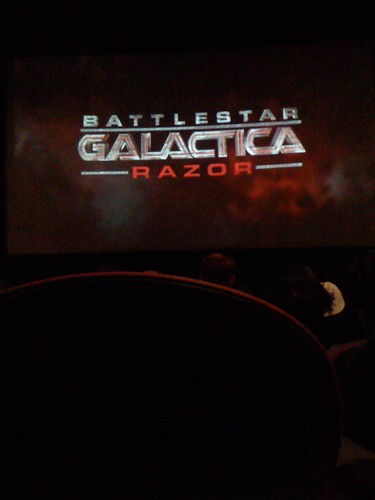
Last night, kwc and I caught a free preview showing of Battlestar Galactica: Razor, a story that takes place following the Cain story arc with flashbacks as appropriate filling in the gaps between the attack on the Colonies and Galactica.
Unlike a normal movie showing, because this was sponsored by Microsoft, we were subjected to ads from before, during and after the movie. After the movie, we saw ads from Sci-Fi Channel, including some scenes from the upcoming season (starts in 2008?), as well as more extended version footage from the Battlestar Galactica: Razor DVD.
We were subjected to this Microsoft Zune ad twice during the showing:
While I would be perfectly okay with never seeing this ad ever again, I think the ad exemplifies the difference between Microsoft Marketing and Apple Marketing. While Microsoft is more involved with the abstraction of what a music experience is like (in the Zune's case, it's a weird kind of acid trip with dancing pink bunnies), Apple is more concerned with keeping the product on the screen or showing off the features of the device.
-
Yes, it is as bad as it sounds.
-
Series preview for Macross F, Macross co-creator Shoji Kawamori, Macross Plus composer Yoko Kanno, and Macross Zero's animation studio Satelight are working on this 2008 TV series.
-
Going straight to the heart of gaming addiction -- at BlizzCon 07.
-
Scenes from the movie Aliens recreated with LEGO bricks
-
Media Bias of Coverage of climate change. U.S. vs. U.K.
In case you haven't heard, guild writers are currently on strike, picketing the studios so that they can get some residuals on digital downloads and dvd sales. They're asking for 4 cents, and my guess is that they probably aren't going to get four cents -- they're likely to get a penny or two once things are totally negotiated out, but in the meantime, the network is still doing digital downloads, and in fact, NBC, which had previously blasted Apple for not wanting to raise their price from 1.99, has dropped the prices on their shows on Amazon Unbox to just 99 cents per show
-
40 boxes full of old outdated videogames
-
Normally I don't read AICN, but they had a nice post about where the writer's strikes are taking place, and what shows are essentially shutdown.
-
An Interview with Ron Gilbert for the 10th Anniversary of Secret of Monkey Island
-
The 95 year old blogging granny (you can practice reading Spanish)
-
Derek Kirk Kim, Gene Yang and Adrian Tomine, featured in an article about Asian American Comics.
-
A PR release about a company trying to release Linux games on the "ransom" model. Their first game's ransom is $40,000.
Lately, I've been thinking about creative re-use of technology, which usually means I've been spending too much time looking at MAKE or Instructables. When littlestar was showing me some novelty usb drives, what kept running through my mind was "Hmm. I could make that. All I need is..."
Of course, seeing DataMancer's wonderful steampunk laptop got me thinking about things too, particularly about materials. Although we can house computers within just about anything these days, for your average consumer, they often come in plastic or metal cases, and they pretty much look like any other computer. Every once in a while, you hear about wooden peripherals or one that has leather accents, there isn't use of much other materials. There is a practical reason of course to not using fabric on computers, and that's cleaning, but why has has laptop design not substantially changed in the last 15 years?
In 1993, my parents bought me a laptop to take to school. It was one of those generic deals that you'd be able to find in a mom and pop computer store, equipped with a 486 processor and with 33 mhz of processing power, it was as fast as my desktop computer at home, and amazingly I was able to play SimCity 2000 on it. The keyboard was built in, and the 7 inch screen was monochrome with 256 shades of gray, it had a 10 megabyte harddrive and it cost about $2000. It also weighed about 10 pounds. No built in modem or network card, not even a built in trackpad. But it was clad in the all-too-familiar black plastic shell that still wraps modern laptops today.
Now, through the advancement of computer technology, you could make that same machine today for a fraction of the cost, with all sorts of bells and whistles attached to it, and make it still cost a great deal less than two grand. Much of this has to do with the falling prices of components, and the progress of technology. For example, you can now buy an ASUS eee PC with an Intel Mobile processor, 512 RAM, a 4GB flash drive, 7 inch screen, built in webcam, speakers, network card, and weighs just 2 lbs for $400. While 4GB of drive space doesn't seem like a whole lot, it is enough as long as you use mostly web applications and don't do any graphics work. The ASUS eee PC comes with Linux pre-installed, (Windows is also installable, as they include the drivers) The move to using solid state electronics (no moving parts) and using a flash drive instead of a hard drive is a big step. While larger flash drives are still more expensive than the traditional hard drive, it has the benefits of a smaller physical footprint, less energy consumption and greater reliability, I see flash drives going forward for consumer computers, and replacing physical hard drives for devices in which size and weight will make a difference.
Asus isn't the only one thinking about replacing hard drives with flash, Dell has recently unveiled the M1330, which also uses a 64 GB solid state device (as a $1000 upgrade).
This video needs a little explanation. It's an Indian homage to Thriller. Obviously, the native language is Hindu, but someone subtitled it based on how the lyrics sounds in English. The mishearing of the lyrics is pure comedy.
Yesterday Google announced that they'd be setting up a new venture called "Open Handset Alliance" their partners? Everyone too lazy to make their own open or closed mobile platform. Companies with their own mobile platforms (Apple, Symbian, Palm, Microsoft) made some comments regarding Google's encroachment onto their territory.
Microsoft
"It really sounds that they are getting a whole bunch of people together to build a phone and that's something we've been doing for five years"
Nokia:
"We don't see this as a threat."
Palm:
"If Google was not involved the industry would have just yawned and rolled over. We take it seriously but we are the ones with real phones, real phone platforms and a wealth of volume built up over years."
Apple:
"We have a great relationship with Google and this doesn't change anything. They are certainly an important partner for iPhone."
To clarify, Google isn't making phones, but rather building an interface/OS for other phone manufacturers to use. The first Android OS equipped phones won't be making their way to us until sometime in 2008, but the problem I see is that there isn't a revenue model attached to it -- the Android OS will be open source, so Google won't be monetizing it directly, it's definitely another step for Google into getting onto your machine and using their systems.
-
MSN Match article about what your video game console says about your guy. (Highly inaccurate, but humorous).
-
Geez! Why? Why do we need a second G.I. Joe: The Movie? Because the first one did so well?
One of the things I've been thinking about lately is what makes things cool. It's a lot like the current websites that are considered cool. I'm not on facebook, I don't use twitter, and I don't really understand the appeal of myspace with the kiddies (the pages are an eyesore, and filled with noise).
One of the cars I thought was ugly from it's inception is the Scion XB.  Apparently for teenagers, this is the cool car. I really don't see the appeal, but this is what kids like these days.
In my day, this was the car most teens worshipped: the Lamborghini Countach. Sleek, beautiful, exotic, it was a car that none of us would probably ever own, but it was a dream car, and it was cool.
 . Of course, my tastes definitely skewer towards the sleek and beautiful cars, as my current cool car is the Tesla Roadster.
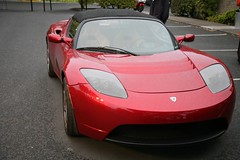
It's fully electric, it goes 0 to 60 in 4 seconds, and it's wonderfully sleek. I want one. Eventually. But I've sat in the second prototype. It's really low to the ground, both inside and outside -- you are sitting on the floor, and I can't imagine this thing not getting scuffed up anytime there's a dip or a speed bump.
Four years ago, I had a meeting with Richard Garriott, a.k.a. Lord British of Ultima/Origin fame. His company was working with NCSoft back then, and NCSoft had sent him over as an ambassador of sorts to look at what we were working on, and to get to know the people. His game that he was working on back then was a MMOG called "Tabula Rasa". Well, Tabula Rasa came out last week, but they've released it as "Richard Garriot's Tabula Rasa".
I have a couple of problems with this title, and the first has to do with Richard Garriot's name being part of the actual title of the game. For one, having Richard Garriott's name there doesn't help sell the game. Unless you're a total game geek (or astronomy buff) like me, you probably have no idea who Richard Garriott is. First off, he's the son of astronaut Owen K. Garriott (Skylab) and crazy collector of astronomy associated items (he owns one of the Sputnik satellites). On the gaming side of things, Richard Garriott is the creator of the Ultima series of games -- you might call him one of the pioneers of the game industry -- he programmed a game by himself and sold it in Ziploc bags at his local computer store. But Richard Garriott's name, for the most part, means very little to the average gamer.
Secondly, having the title of game be called "Richard Garriott's Tabula Rasa" makes it seem like it's all his, and while he probably did come up with the idea or the design, but what about all the countless other programmers and artists who also worked on the game? Sure, you can't call it "Richard Garriot and Programmer A and Artist Z's Tabula Rasa", but the whole notion of adding his name to title seems to pay little credit to the others who contributed to the game. I wouldn't even mind if it was on the box like "Tabula Rasa, created by Richard Garriot" or "Richard Garriott Presents Tabula Rasa", but the whole thing of crediting a single person in the title just strikes me as being a little too pretentious to me.
In the end, Tabula Rasa is just another sci-fi themed MMOG, which is likely destined for the discount bin in 6 months time.
-
Remember, remember the Fifth of November,
The Gunpowder Treason and Plot,
I know of no reason
Why Gunpowder Treason
Should ever be forgot.
Guy Fawkes, Guy Fawkes, t'was his intent
To blow up King and Parliament.
Three-score barrels of powder below
To prove old England's overthrow;
By God's providence he was catch'd
With a dark lantern and burning match.
Holloa boys, holloa boys, let the bells ring.
Holloa boys, holloa boys, God save the King!
When Apple first announced that as many as 250,000 were sold to people with the intention of unlocking them, I thought those numbers were a little bit off, but after thinking about it, Apple has a very easy way to know how many were sold to unlockers, and that would be by comparing it to the number of activations on AT&T's network to the number that had been sold. Apple gets a decent amount of change from AT&T for each AT&T subscriber, so Apple would have access to both the number of iPhones sold, and the number of subscribers. Whatever number is left over must be the number of iPhones that are unlocked and running on other carriers, which, as revealed in the post-earnings conference call may number as high as 250,000. To clarify, these are not unlocked iPhones, merely unactivated iPhones, and as such, Apple isn't enjoying the nice kickback from AT&T ($20 per iPhone, per month) on these unactivated iPhones.
Shortly after the number of unlocked iPhones were announced, Apple announced that the new Apple Store policy would be to stop accepting cash/gift cards for iPhones. Then I read this story about three guys who flew in from Amsterdam to bring 15 iPhones back with them using the 5 iPhones per person limit (from the San Francisco Apple Store), and another story about a ZD editor going into Apple undercover and attempting to purchase the iPhone with cash after the credit card rule went into effect. Apple has said it's a maneuver to prevent resellers from purchasing iPhones, as well as to try and ensure enough stock in the stores for the holidays.
Even so, I've started to put several of the pieces of the puzzle together.
Apple's iTunes Store, restricts music purchases only to people living in that country. If I want to say purchase a Japanese track off the Japanese iTunes store, I can't do it, as it checks my address and my credit card, and says "You're not living in Japan, you can't download this digital file". But, if I purchase a Japanese iTunes card, I can go ahead and purchase my song. I have a feeling this is likely going to be the same way it works with iPhones soon. With the launch of the iPhone soon in Europe, Apple has to clamp down on resellers and tourists in the United States who are turning a tidy profit by purchasing iPhones in the US and shipping them overseas. Were this a Mac or a normal iPod, Apple wouldn't care -- they can deny warranty service if the device ever comes into their hands, and there are plenty of other people/businesses out there who would fix a broken Mac or iPod. However, by controlling the point of purchase, you can limit the number bring exported, simply by checking whether or not the credit card is an American credit card, and whether or not they've made purchases of iPhones recently.
A good deal of Apple's money comes from the deal with their partner carrier. For AT&T in the United States, this amounts to $20 a month, a tidy $480 for the length of the 2-year contract. As the iPhone rolls out internationally, Apple turns a huge profit on the iPhone. If Apple has to deal with a quarter of all buyers who intend on unlocking their iPhone, Apple will be able to meet their sales goal, but their profits will suffer considerably.
Apple's iPhone requires syncing with iTunes to download playlists, and is returned to it's cradle every so often to charge, iTunes also manages the iPhone updates, and with each update, the iPhone is able to become relocked. If it becomes too troublesome to unlock, or bricked as a result of the unlock, Apple benefits, as people either switch to using their local iPhone carrier or stop using the iPhone.
Since the release of TiVo and the release of the DVR, my broadcast TV viewing time has dropped to zero. With more and more TV series being released on DVD, or available on the internet, there is absolutely no reason for me to see it in real-time (I should add that I don't bother to keep up with sports -- for such things, I realize that broadcast TV is necessary). Right now, there are only two shows that I presently watch weekly: Heroes and Avatar: The Last Airbender. I'll catch episodes of Chuck, and The Office occasionally when I need to run something in the background, but for the most part, it is primarily DVDs and movies that I watch these days. Partially this is because I don't have time to go to the movie theaters that often, and DVDs allow me to watch my movie on my own time. With all of this being said, how important is it that there is a Hollywood Writer's strike going on right now?
Pretty damn important.
What the Writer's Guild is fighting for now are royalties over the sale of DVDs and internet broadcast/download rights. In the pre-internet era, writers got coin every time a tv station aired their TV show. The show was paid for by advertising during the commercial breaks on the tv show. With the rise of internet broadband, media outlets started putting up ways to view their TV shows online (last year for instance, I kept up with Heroes by watching the episodes off NBC's website). Even though NBC is placing advertising across these episodes, supposedly the cost goes in paying for bandwidth, and not lining NBC's pockets with cash. After all, NBC only made 15 million from the iTunes store last year. With the release of shows on DVDs, TV networks have figured out there's more money to be made in milking the consumer for dollars by releasing DVDs rather than try and sell the show as a syndicated program (also, take into consideration that syndication requires enough episodes and success that there needs to be a minimum of 65 for daily weekday broadcast, and 22 for weekly broadcast). When programs are syndicated, writers get paid royalties, but when shows are released to DVD or direct download writers aren't paid (unless they negotiated something individually).
The end result of guilds and unions is that they serve as a bargaining collective to protect the members of the organization from unfair treatment by businesses. NBC, if you didn't know, is owned by GE, and GE announced their earnings about a month ago. GE reported a 14 percent increase in net income the third quarter, while NBC's increase for the quarter was a 9 percent jump in profits, taking in $589 million this past quarter -- NBC has had 4 straight quarters of profits, taking in a total of 2.2 billion dollars so far in 2007.
NBC, if you haven't noticed, has been quietly sabotaging their own online website to fuel their Hulu startup. While NBC has been bold enough to call the $15 million from iTunes "pennies", one should also notice that no other media company with a partnership to iTunes has announced their iTunes earnings, or been stupid enough to ask Apple for a piece of iPod hardware sales, one wonders if NBC also asked electronics manufacturers for each radio and TV they sold.
I don't think this strike will be resolved quickly -- and in the meantime, expect to see mid-season replacements and re-runs filling in airtime as the strike goes on.
-
Computer Game Museum in Berlin recreatse the arcade classic Donkey Kong.
-
Brilliant -- Adam and Jamie from the Mythbusters as a Costume.
Brian Williams explains:
Now you know, and knowing is half the battle.
-
How to make your own Life-size Jabba the Hutt. Irrigation tubing, foam and hotglue FTW.
-
I'm always stunned by the creativity of fans
-
Some really creative pumpkins.
-
Tokyo Design Week
The good folks over at Penny-Arcade launched Child's Play 2007 yesterday, their annual charity drive to raise money for children in hospitals. Each year, Child's Play has managed to shatter the previous year's record. Select a hospital, select a toy, and do good.
Today I actually attended two events with Fake Steve Jobs (a.k.a. Dan Lyons). Both were in San Francisco
There's a pattern to these presentations is that Lyons follows, which is that instead of reading from the book, he simply talks about how and why he started doing Fake Steve Jobs, and the craziness that ensued in trying to figure out who Fake Steve Jobs was.
The first presentation at Stacey's Books was fairly low key -- with only about 20 people in attendance, a local photographer from a Bay Area newspaper was taking photos. I had actually arrived only a few minutes before he began, which resulted in me handholding the camera to tape the video footage. He starts by leading off with a recap of his Menlo Park event last night, and Andy Hertzfeld was also in attendance at Menlo Park, and the opening of Option$ is actually inspired from Hertzfeld's book Revolution in the Valley. Hertzfeld had read the begining of the book and said "Yeah, I recognize that story".
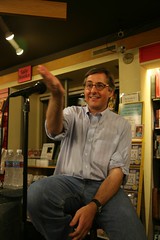
The second presentation, at 7:30pm at a Books Inc. in Castro Street was also low key -- unlike Menlo Park last night, which was packed with people, with not a chair leftover, there were seats available, but late arrivals instead huddled in the back, as the only seats left were the ones in the front. I didn't really like the layout of the area -- FSJ and I were basically in foot kicking range of each other. This event also had many faces of the blogosphere in attendance -- Ryan Block of Engadget, Veronica Belmont of Mahalo, Leander Kahney of Wired's Cult of Mac, as well as the much touted appearance of Bike Helmet Girl.
FSJ starts with a hello to Bike Helmet Girl, and a story of how Bike Helmet Girl came to be. He gives the story of how he started the blog, and how it became a book deal, as well as the hunt for Fake Steve. A lot of the information he uses to write the blog comes from readers who send him e-mail, and he tells the story of how he initially started calling Jonathan Schwartz of Sun "Ponytail Boy", but changed it to "My Little Pony" when someone from Sun wrote to him said "No, no, no we have a name for him, we call him My Little Pony".
Midway through his talk about how he started the blog, he sees Veronica Belmont and Ryan Block appear, and he's ecstatic:
Engadget Editor Ryan Block asks him a question on how he manages to channel Steve:


-
Is a writer's strike coming next week over digital distribution rights?
The Fake Steve Jobs (a.k.a. Daniel Lyon) is on a book tour promoting his book Options: The Secret Life of Steve Jobs, A Parody, and he made a stop at Kepler's Bookstore in Menlo Park. What makes this book reading different from others is that they managed to get the real Steve Wozniak to show up, and give the introduction to Fake Steve Jobs. I'm in the front row, sitting next to the editor of Valleywag, Owen Thomas, who is liveblogging the event. A couple rows back from me is Brian Lam of Gizmodo. A couple of other names and websites were tossed into the air before the event started and I'm assuming a lot of the crowd here probably reads alot like a who's who of the blogosphere. I don't really recognize them, I'm just here to listen to Fake Steve Jobs, and hopefully take some pictures and video.
Wozniak gives a really geeky introduction to Fake Steve Jobs. I mean really, really geeky -- he's talking about hotel rooms and breaking down the room numbers down into base pairs, and then does a bit of numerology breaking down Daniel Lyon's name into 4 and 12 with 12 breaking down into 1 and 2, and all of those are powers of two. At the end of Woz's intro, he gives a FSJ a real Apple turtleneck which he purchased from the Apple Company Store. FSJ is reluctant to wear the turtleneck, as he is afraid the Apple lawyers might say he's hitting too close to the mark.


FSJ is totally geeked out by this intro from Woz, and wants a picture of him and Woz together. There are plenty of cameras in this room, and things pause for a minute as they get that picture. FSJ ranks this event pretty highly -- just under the birth of his kids.


Fake Steve Jobs launches into how it all started, as really an exercise in learning how blogs worked, and he didn't want to do a normal blog, and he was inspired by British magazine Private Eye, which had a "secret diaries" feature. He was a big Apple fan, a switcher from Windows to Mac OS X. Stuff would happen in the news, and they wouldn't cover it in Forbes, and so he started wondering "I wonder what Steve Jobs thinks?" and styling the blog like that. He did it for 6 weeks, deleted it and then someone said "dude, what happened?". So he put it back up. He put a book proposal together at Christmastime, and then scrapped it later to start to put a storyline together involving the SEC and the iPhone. Trying to keep his identity as FSJ from his Forbes co-workers was pretty tough, especially when the bonus for discovering the identity was a free iPod. However, his Forbes co-workers were clueless, even when they figured out that FSJ was in Boston, they never realized it was him (who was living in Boston) at the time. It ends with the outing of FSJ, and Forbes adopting FSJ onto their website (and now includes the super annoying ads that run across the screen).
FSJ then begins the question and answer section, and relates the story of how he tried to outrun the Valleywag outing, and how the New York Times managed to uncover his identity.
His favorite blog entry is the one on the day the iPhone shipped, called "The Day the World Changed", because he got to satirize a lot of it, and he really finds the whole camping thing ridiculous. Woz pipes up at this point and relates a story how he printed up a bunch of numbers for people and handed out tickets so people wouldn't lose their place, and how he got to ride around Valleyfair Mall in the middle of the night on his Segway while camping for the iPhone.
Someone asks FSJ if he was also Fake Larry Ellison, and his answer is no. What happened was that he needed to finish the book, and so he rented a place in Maine to finish it, and set up one of his friends who had always wanted to blog as a user for his blog as the Fake Larry Ellison. He also offers Woz a place on his blog as a guest blogger as well. During this time, he was outed, so he had to come back from Maine and drive back to Boston to deal with it.
FSJ says that he's never been contacted by Apple for any reason.
Regarding journalists, he is one, so he's sort of self-loathing in the way that he portrays them and how CEOs respond to them.
Owen Thomas of Valleywag asks "How do you know when you're being you, and when you're being FSJ?"
He thinks of it as being sort of like Triumph, the Comic Dog. He did some posts recently on Scoble and EMC, and he's pretty sure that Real Steve Jobs probably doesn't think about Scoble or EMC at all. The real person who does Triumph, "Rob Smigol in real life is this really quiet, nerdy soft-spoken gentle guy, not very funny. Stick a dog puppet on his hand, and he goes mental." "I'm really not like Fake Steve, but it comes out."
He's only had one person help him out on the blog. He lets go of characters as he gets bored of them.
Someone comments that his Nancy Pelosi is spot on, and wonders if he's ever met her, and the answer is a loud "Ha" followed by an explanation that he totally made that up.
FSJ loves the interaction between the commenters and the entries -- and he intentionally makes mistakes just to see the commenters' reactions to them. His real job is covering Linux, so he gets comments sometimes, and pulls off a mocking voice as to how Linux people generally respond to his columns.
Did FSJ invent frigtard? No, he thought he did, but apparently someone had beat him to it.
He's supposed to meet bike-helmet girl on this trip, and will probably meet her in San Francisco at the reading at Books Inc. in the Castro District tomorrow.
Last question: Did he actually get a raise at Forbes? No, he didn't, but he has some kind of deal worked out in relation to the traffic that he gets on Forbes.
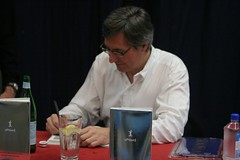

Flickr: Fake Steve Jobs (a.k.a. Daniel Lyons) and Steve Wozniak.
Every year at my elementary school, they would have a Halloween Parade, where you'd either bring your costume or wear your costume to school. While my parents rarely dressed up, they'd often buy us a costume, and send us to school with a Ben Cooper costume in a box. When I say costume in a box, I mean quite literally a costume in a box -- the $10 box contained everything you needed to transform yourself from ages 5 and up to whatever you wanted to be that Halloween. The box contained a plastic mask of the likeness' face, and a vinyl overall which would be open in the back. You kept the weird overall thing from falling down by tying a series of fasteners in the back, and because these things had sleeves, the armholes would presumably keep the whole thing from slipping down. The overalls being made of vinyl were clearly labeled "Inflammable" with a big fire symbol on the box. Had I and my parents realized at this age "Inflammable" and "Flammable" mean exactly the same thing -- that the object can quickly catch fire or ignite, I doubt that my parents would have let me wear it, even if it was only for the few hours we spent trick or treating or in the elementary school parade.
The plastic mask which came with the costume were terrible, but as kids we loved them for their ability to quickly transform us into someone we were not. The plastic that sometimes cut into our faces as we pulled the mask up or down, and the constant reattaching of the elastic that held the mask to our faces were little inconveniences, but by Thanksgiving, usually the mask was destroyed by that point, and it'd be another year before we got more masks.
As children, we were suckered in by the masks -- they did really look like the character we wanted to be for Halloween, but the overalls were terrible -- most times they'd just have the logo of the licensed property emblazoned across the chest along with a picture of the person you were supposed to be -- to make it easier for adults to say "Oh my, what a cute (fill in the blank) you are!" when they open the door to hand out candy. Sometimes this led to rather embarrassing situations, such as when some old lady would open the door see the "Star Wars" logo across your chest and say "What a nice Star Wars you are!" instead of identifying you as Luke Skywalker.
Which leads me to the present day -- I don't really buy my own costumes anymore -- I make my own costumes, usually with things that I can get year round, or with items of clothing that already exist in my closet. I may pick up a few items here or there to help accentuate the costume, but on the whole, the goal is to keep it cheap (but still look good). I've had some rather elaborate costumes in the past -- an Incredible, Anakin Skywalker and Batman, but this year, I opted for something simpler. In fact, the only thing this costume cost me was eyeliner and a pencil sharpener, as I had the jeans and shirt.

Going to school in Berkeley, I always heard the name Chez Panisse bandied about. Chez Panisse was the place for special and momentous occasions -- while one might go to Henry's for a round of birthday drinks or splurge on sushi at Kirala, but Chez Panisse was the right answer whenever anyone offered to treat you to dinner, because meals there were expensive. There are things I wish I had known while going to school in Berkeley -- mostly to do with food, because I ate out constantly, and cooked little. There are some that will balk at Chez Panisse for having $65 - $85 dinners (these were more like $40-60 when I was going to school) and on a student budget, you'can't really drop that kind of money on a meal when each of your textbooks cost that much.
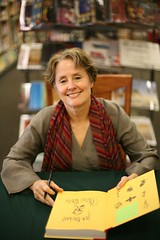
Alice Waters is one of the founders and co-owner of Chez Panisse, and is also one of the strongest advocates for locally-grown and sustainable agriculture. She's just published a new cookbook called The Art of Simple Food : Notes, Lessons, and Recipes from a Delicious Revolution, and this afternoon did a book signing at Books Inc. in Palo Alto. I was slightly disappointed that it would simply be a signing, and not a reading, but the Palo Alto Books Inc. is not large, and accommodating large groups of people with sitting space would be nearly impossible at this location.